


AMF re-allocation lets the 5G Core reroute an ongoing Registration Request when the initial AMF is not suitable to serve the UE. The slice-driven case below addresses a practical question: why can an AMF change after the gNB has already forwarded the request? The answer depends on information available at selection time, subscription data and the conditions for transferring the registration.
Why the First AMF Selection May Be Provisional
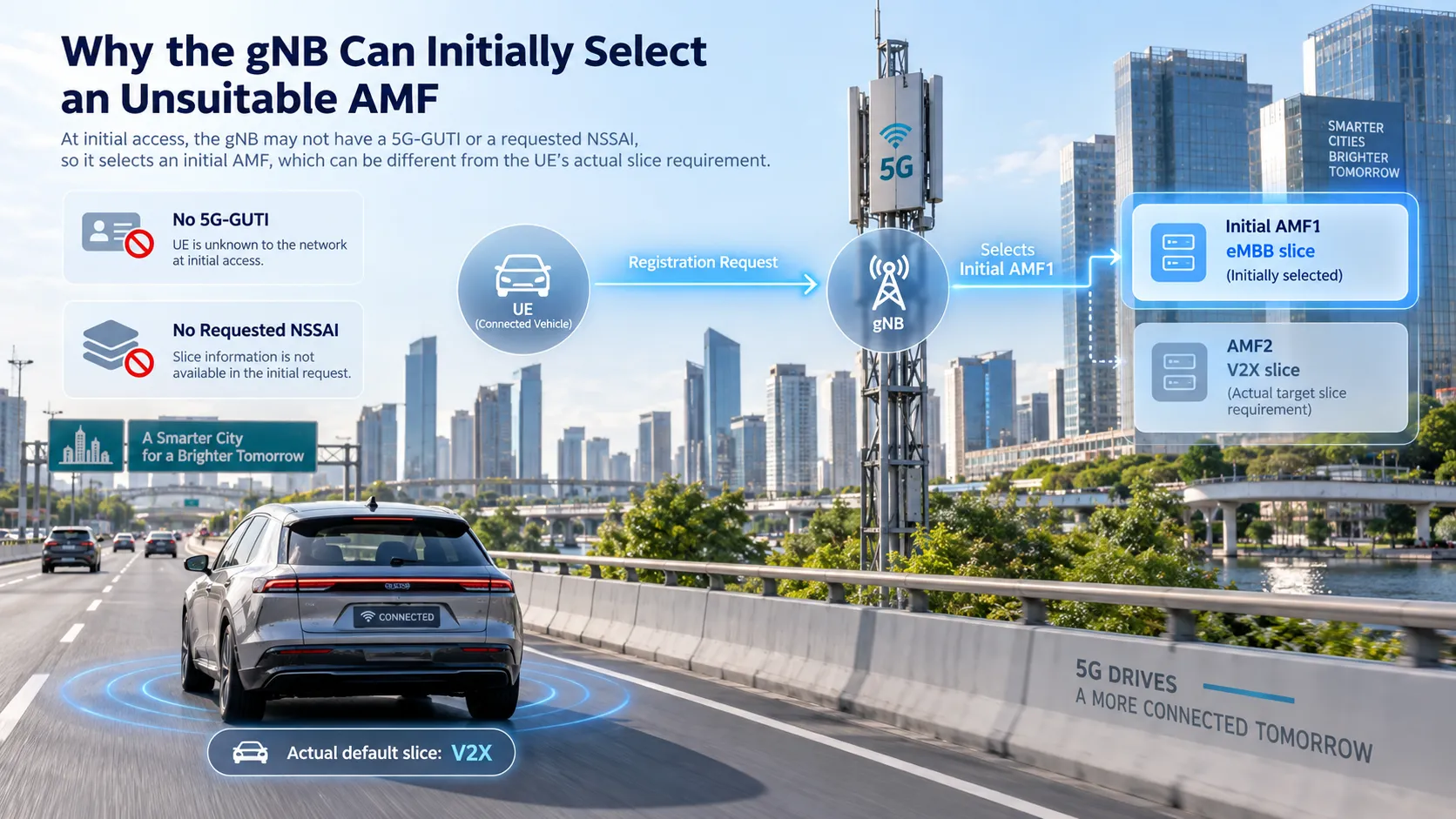
The gNB selects an initial AMF using available access-network information and configuration. RRC information such as a temporary identity and requested slice information can help this selection; the gNB does not first retrieve the subscriber’s complete UDM profile or interpret NAS as the AMF does. An NGAP Initial UE Message carries the NAS Registration Request to the selected AMF.
Consider an illustrative connected vehicle subscribed to an eMBB slice, S-NSSAI1, and a V2X-related slice, S-NSSAI3, with the latter marked as default. These labels describe an example configuration, not standardized slice identifiers or a guarantee of automated-driving service. If no usable 5G-GUTI or Requested NSSAI is available, the gNB can select AMF1 from its available information. Missing Requested NSSAI alone does not require re-allocation.
Subscription Data and Slice Selection Refine the Decision
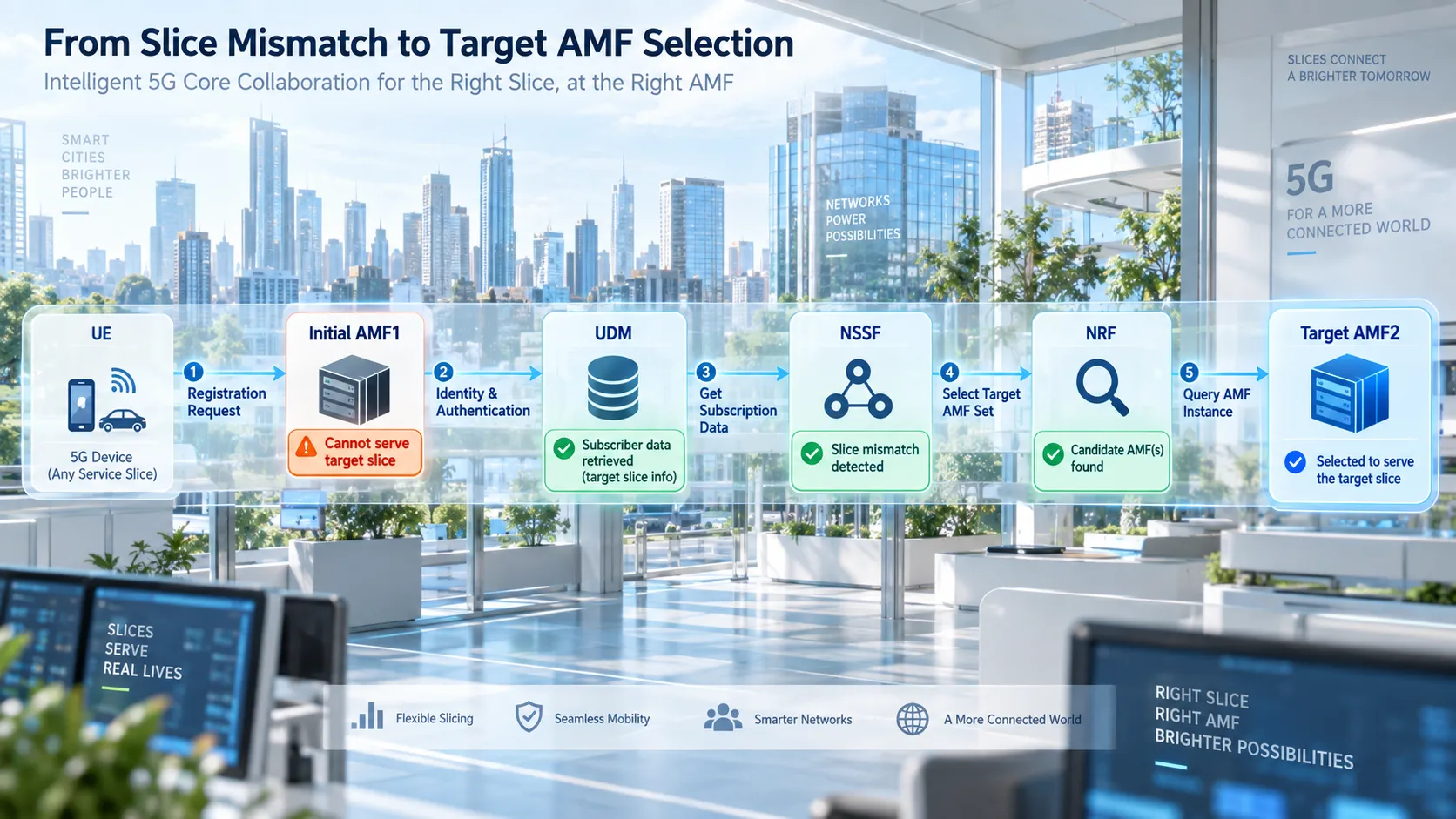
The initial AMF performs identity, context and security processing when required to make the rerouting decision. It does not always repeat a full authentication sequence before consulting the NSSF. If necessary slice-selection subscription data was not obtained from an old AMF, it selects a UDM and uses Nudm_SDM_Get to obtain subscribed S-NSSAIs and default indications.
In the vehicle example, re-allocation becomes relevant if the authorized slice selection requires an AMF capability that AMF1 cannot provide. A default S-NSSAI is an input to selection; it does not by itself force relocation. The requested slices, subscription, location, network configuration and AMF capabilities must be considered together.
When slice selection is needed, Nnssf_NSSelection_Get can supply the NSSF with Requested NSSAI, subscribed S-NSSAIs with default indications, TAI and other applicable information. The response can include Allowed NSSAI, a target AMF Set or a configured list of candidate AMFs, and conditional configured or rejected slice information. A target AMF Set identifies a candidate scope, not necessarily one final instance.
NRF discovery is conditional: the initial AMF queries Nnrf_NFDiscovery when it needs target addressing and does not already have it locally. Candidate capabilities and selection rules help select a suitable target. A missing NRF exchange in a trace is therefore not automatically an error.
Direct and RAN-assisted Rerouting Have Different Conditions
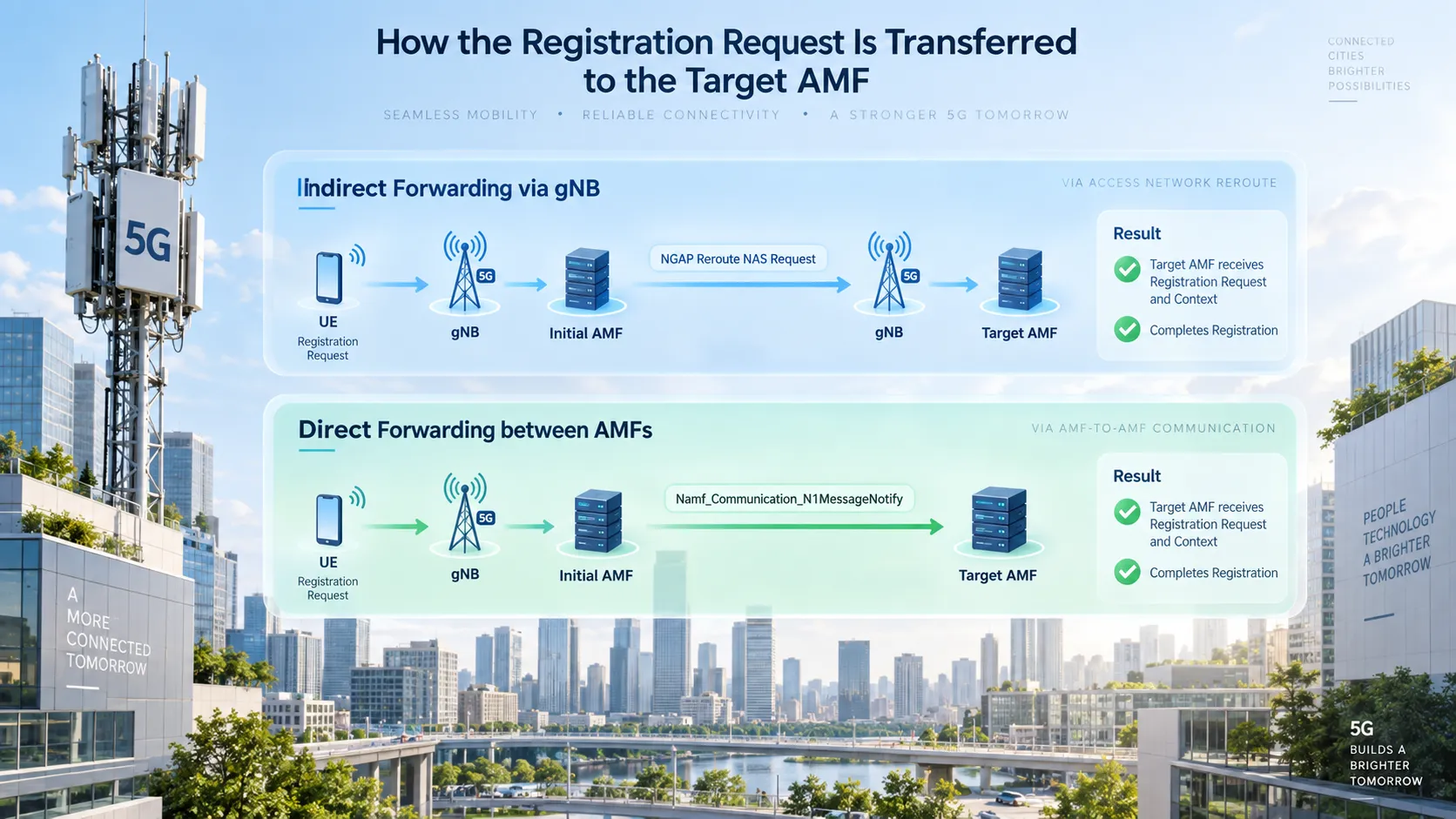
The two paths are not interchangeable choices under every condition. In TS 23.502, if a security association has already been established between the UE and initial AMF, the initial AMF must use direct forwarding. Rerouting through the RAN does not transfer that security context and can leave the UE and target AMF out of synchronization.
Direct Forwarding to the Target AMF
The initial AMF invokes Namf_Communication_N1MessageNotify to forward the complete Registration Request and applicable registration context. This includes access-network information and, when available, SUPI and MM context; applicable information obtained from the NSSF is also carried. The target AMF continues registration and updates the RAN with the new N2 termination information. Local policy and subscription information also influence use of this path.
Indirect Forwarding Through the gNB
For the permitted CM-IDLE-originated case, the initial AMF sends NGAP Reroute NAS Request. The gNB uses the supplied information, including AMF Set ID, to reroute the Initial UE Message to a target AMF. This is network-side NAS rerouting, not a demand that the UE repeat radio access. The indirect branch is not supported when registration arrived in CM-CONNECTED through Uplink NAS Transport; the established-security constraint also applies.
Continue Registration and Check the Actual Failure Point
The target AMF completes the required remaining registration processing. A received security context from the initial AMF takes precedence over one retrieved from an old AMF under this procedure. Registration Accept may provide a new 5G-GUTI and applicable slice information. The UE receives the registration result without needing to manage the internal AMF selection itself.
Check why the request reached the initial AMF: available RRC selection information, initial AMF configuration and the incoming NGAP message.
Verify the subscribed and requested slices, TAI, AMF serving capability and any NSSF result. If selection is conditional or data is cached, do not assume every reference-diagram exchange must appear.
If no target can be selected, inspect the AMF Set, candidate capabilities, discovery results and target reachability. If Reroute NAS Request is sent but no new Initial UE Message arrives, inspect RAN rerouting and N2 connectivity.
For direct forwarding, correlate Namf_Communication_N1MessageNotify, transferred context and the target’s first N2 message. Check security-context continuity before treating the AMF change as a successful transfer.
FAQs
Is This the Same as AMF Pool Load Balancing?
No. The case described here resolves serving-AMF suitability during registration, particularly slice capability. Capacity and weighting can influence instance selection, but two AMFs in a trace alone do not establish either a slice mismatch or a load-balancing event.
Does Every Sliced Network Require Re-allocation?
No. If the initial AMF can serve the authorized slices, registration can stay there. Missing Requested NSSAI or use of a default slice is not sufficient evidence that re-allocation must occur.
Does the UE Send a Fresh Registration Request?
The described rerouting forwards the existing request within the network. The UE sees subsequent NAS registration signaling and may receive a new temporary identity; it does not select the target AMF itself.
Which Forwarding Path Is More Common?
The standard does not establish deployment frequency. Determine the path from actual messages, connection state and security context, rather than assuming either method is universally preferred.
Related Procedures and Standards
General initial registration: identity, authentication and access context
Mobility Registration Update after a registered UE moves
3GPP TS 23.502, clause 4.2.2.2.3: registration with AMF re-allocation