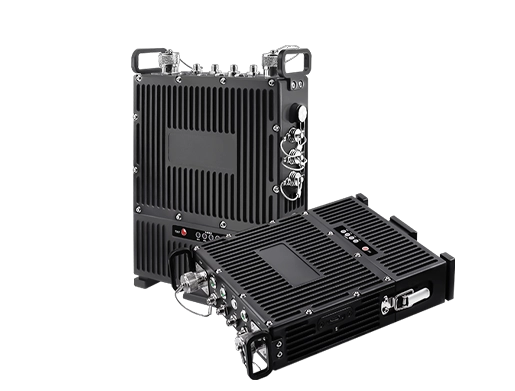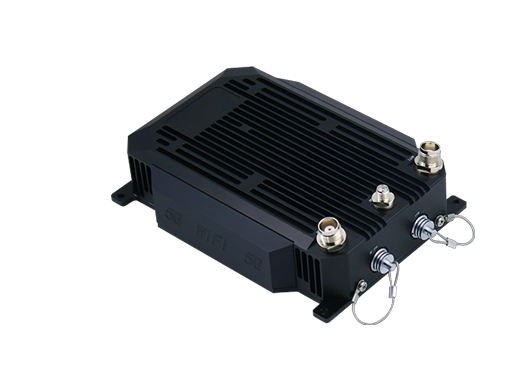


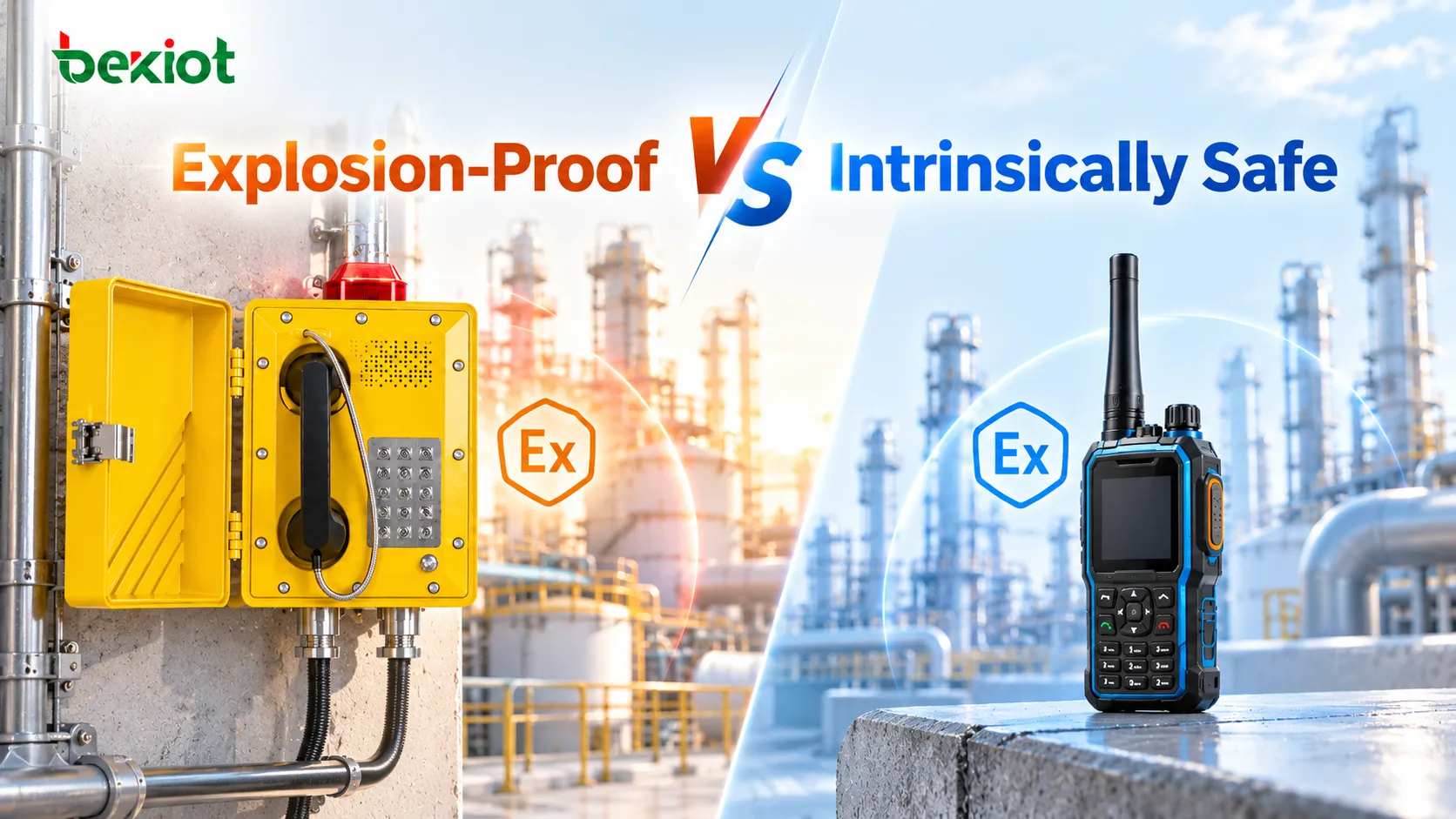
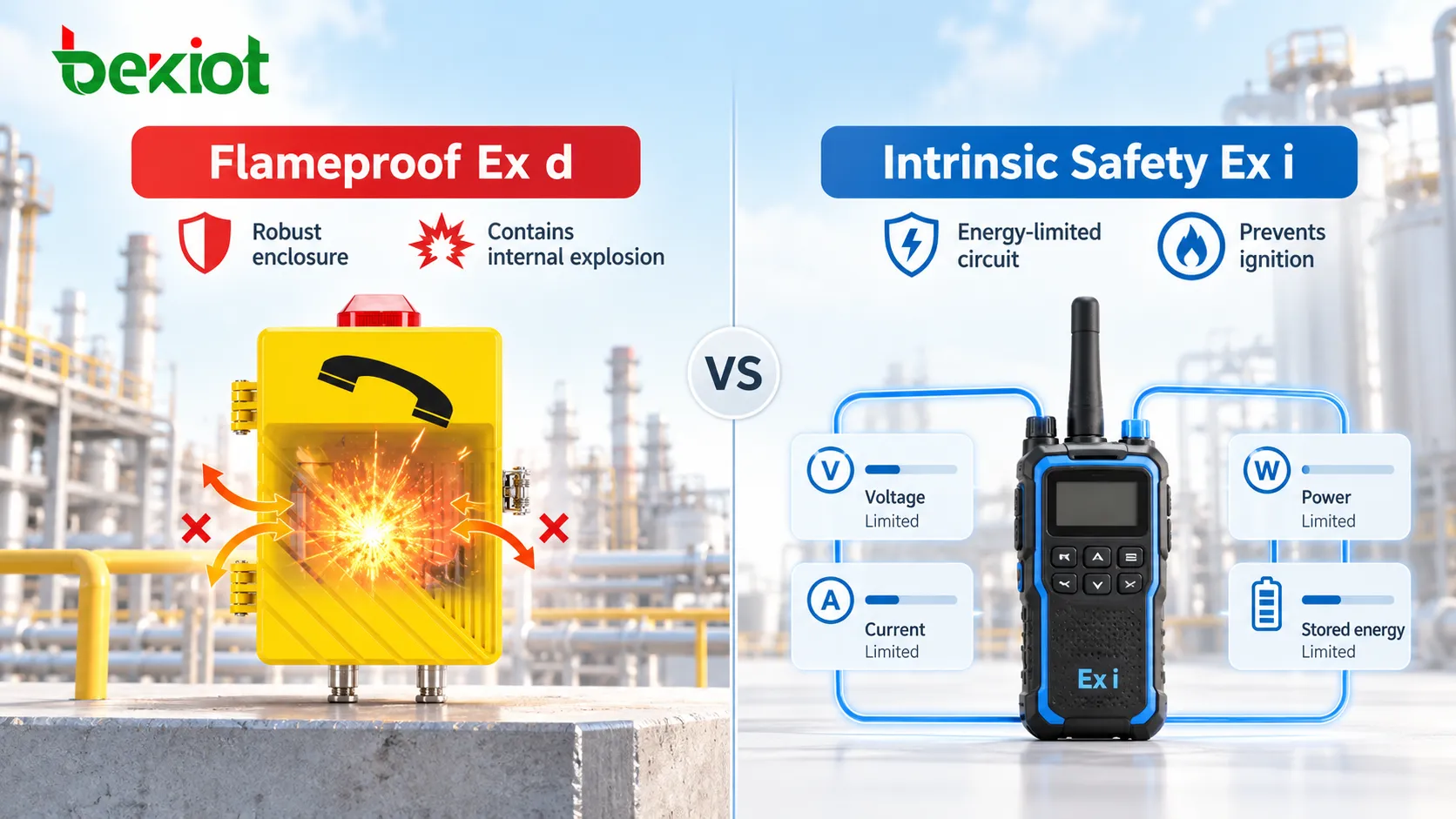
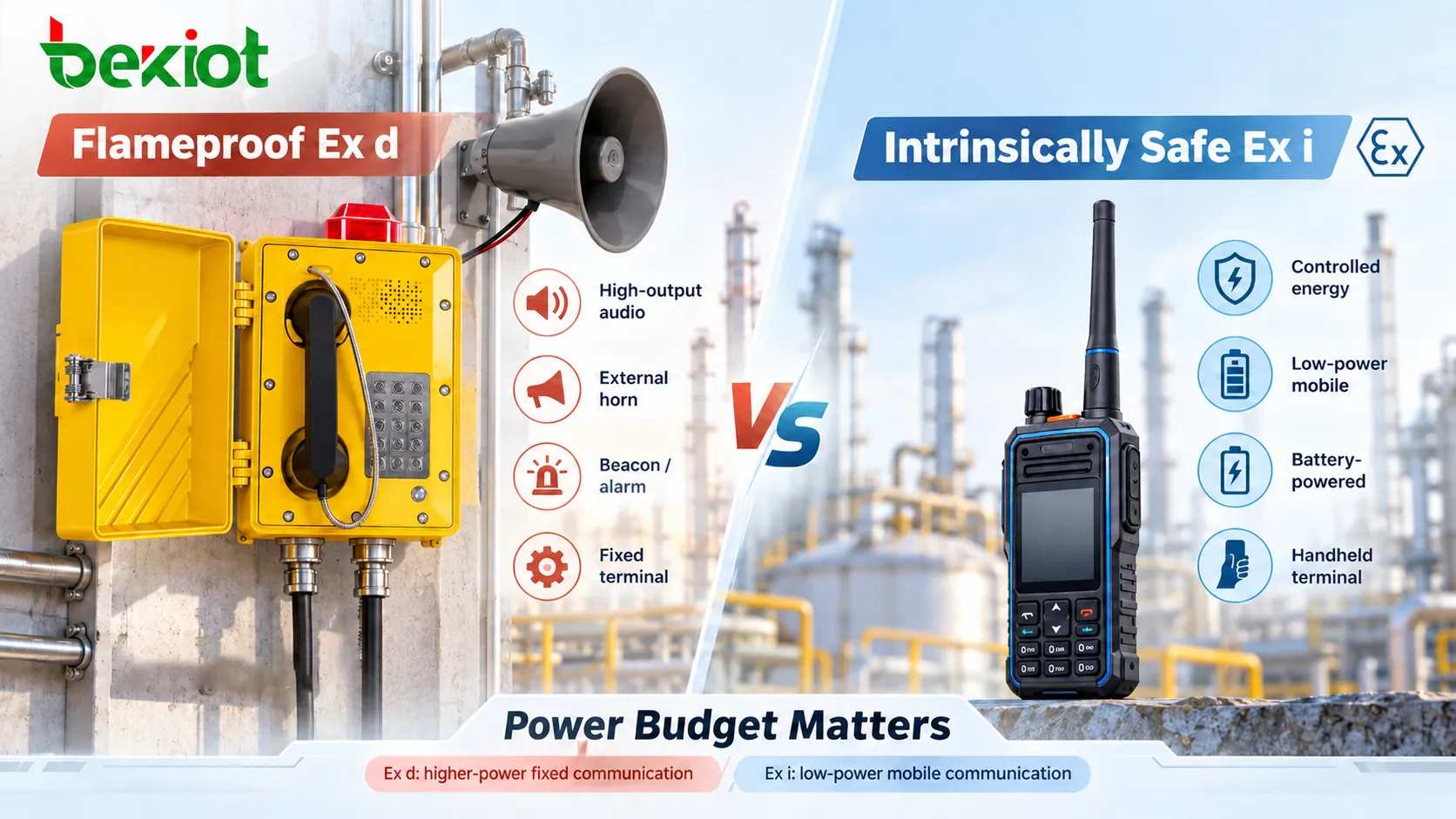
The main difference is the protection principle: a flameproof enclosure, Ex d, withstands an internal explosion and prevents it from igniting the surrounding explosive gas atmosphere. Intrinsic safety, Ex i, limits electrical and thermal energy so that the assessed circuit cannot ignite the specified atmosphere under the conditions covered by its protection level.
For industrial telephones, intercoms and radios, that difference affects more than enclosure weight. It influences available audio power, batteries, external accessories, cable connections and maintenance. Neither concept is automatically safer or suitable for every hazardous location. The complete equipment marking, certificate and installed system determine whether a particular terminal can be used.
What Do “Explosion-Proof” and “Intrinsically Safe” Mean?
“Explosion-proof” needs context. In general product descriptions it is sometimes used broadly for hazardous-area equipment. In North American electrical practice, explosionproof apparatus is a specific protection technique, distinct from intrinsic safety and dust ignitionproof protection. It should not be treated as a universal synonym for every Ex-certified device.
Under the IEC 60079 series, the clearer technical comparison is flameproof enclosure Ex d versus intrinsic safety Ex i. IEC 60079-1 addresses flameproof protection for explosive gas atmospheres; IEC 60079-11 addresses intrinsically safe equipment and associated apparatus. Other concepts include increased safety Ex e, pressurization Ex p and encapsulation Ex m. Equipment may combine several concepts.
IECEx is a conformity assessment system, rather than a protection concept or blanket installation approval. ATEX requirements and North American approval arrangements also have their own legal and technical context. An IECEx certificate or an Ex d marking should not be assumed to satisfy every country's requirements. The OSHA hazardous-location requirements, for example, distinguish Division and Zone arrangements and the protection techniques approved for them.
How the Two Protection Principles Work
Ex d: Containing an Internal Explosion
A flameproof design does not require the inside of the enclosure to remain free of explosive gas. An ignition-capable spark or arc may occur inside. The enclosure and its flameproof joints are designed and tested to withstand the resulting pressure and prevent transmission of the explosion to the surrounding atmosphere under specified conditions.
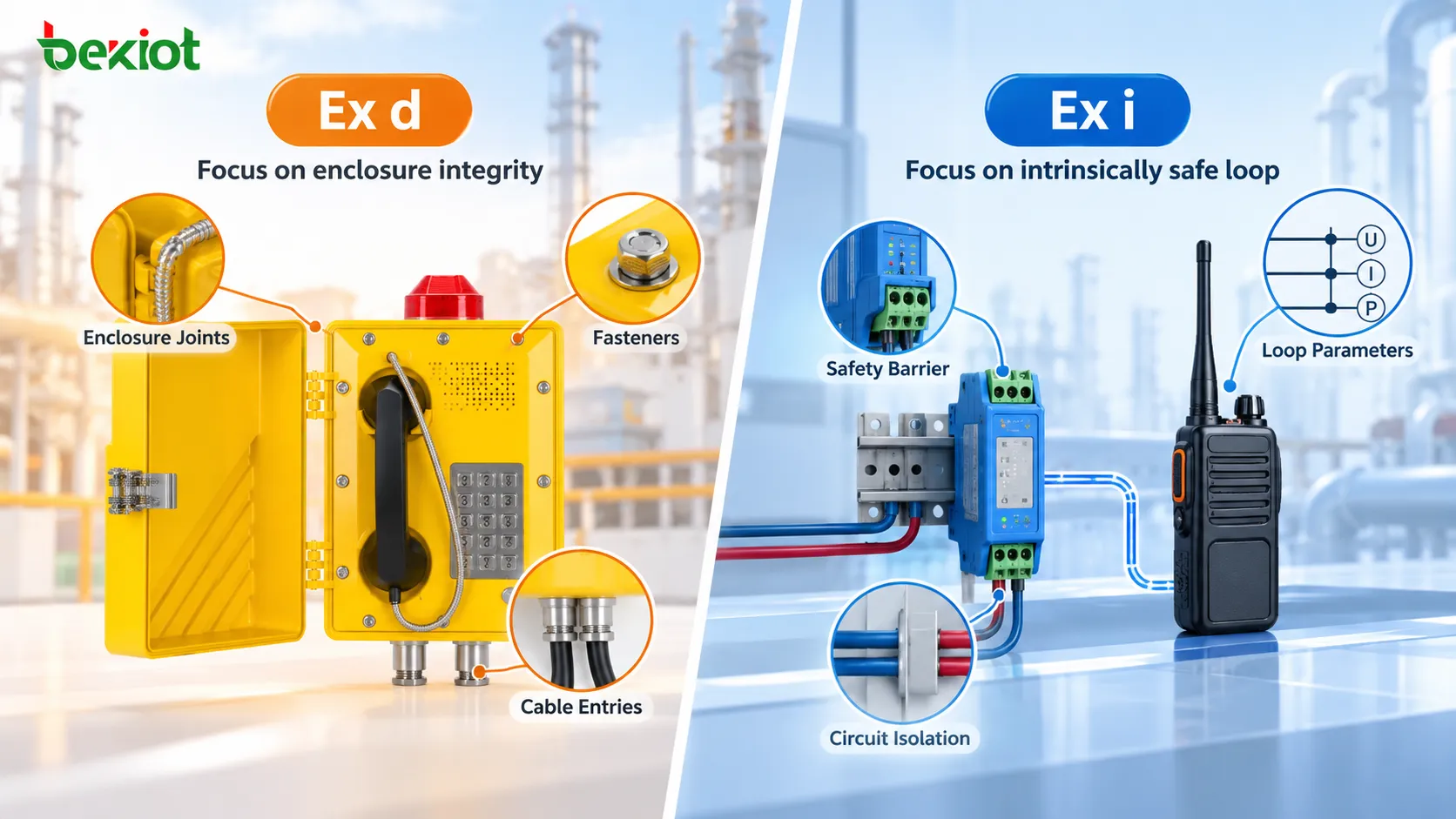
The enclosure is therefore part of the protection, together with the relevant joints, covers, fasteners and entry arrangements. A flameproof joint is not simply a waterproof seal. Grinding its surfaces, substituting cover bolts or drilling another entry can change features on which protection depends.
This approach can accommodate electronics with greater power requirements than are practical within a particular intrinsically safe circuit. It does not remove temperature limits: the complete terminal must still meet its certified temperature and ambient conditions.
Ex i: Limiting Circuit Energy
Intrinsic safety controls potential ignition from electrical sparks and thermal effects by limiting energy in the assessed circuit. Voltage, current and power matter, as do energy stored in capacitance and inductance. The assessment includes the normal operation and fault conditions applicable to the protection level.
That does not mean an intrinsically safe circuit “never sparks.” It means the assessed sparks and thermal effects do not become effective ignition sources for the specified atmosphere under the assessed conditions. Protection can depend on the field device, associated apparatus, battery, connected accessories and interconnecting cable.
| Comparison | Flameproof Ex d | Intrinsic Safety Ex i |
|---|---|---|
| Protection principle | Withstand an internal explosion and prevent transmission outside | Limit electrical and thermal energy in the assessed circuit |
| Critical engineering features | Enclosure construction, flameproof joints, fasteners and entries | Energy limitation, component behavior, stored energy and interconnections |
| Communication design implications | Can offer flexibility for fixed terminals with higher power demands | Requires functions and interfaces to fit the assessed energy budget |
| Typical applications | Fixed telephones, intercoms and alarm terminals using suitable certified designs | Purpose-designed radios, handheld terminals and low-power circuits |
| Important maintenance concern | Preserving enclosure and entry integrity | Preserving assessed circuit, battery and accessory combinations |
A Protection Concept Is Not a Complete Equipment Approval
A robust metal box does not prove Ex d, and a lightweight plastic radio does not prove Ex i. Read the marking and certificate for the actual model and variant. Details such as db, ia, ib or ic identify aspects of protection that the word “Ex” alone cannot convey.
There are three different boundaries to keep clear:
The concept: Ex d or Ex i describes how ignition risk is controlled.
The complete terminal: its assessment covers a defined construction, functions, interfaces and conditions of use.
The installed system: cables, associated apparatus, accessories and installation conditions must preserve the relevant protection arrangements.
A component certificate for an empty enclosure is not evidence that any telephone electronics can be fitted inside and used as certified equipment. Within IECEx, a certificate number ending in U identifies an Ex Component; an X identifies Specific Conditions of Use for equipment. The complete assembly and any conditions or limitations still need to be addressed.
Similarly, two individually certified intrinsically safe devices are not automatically a compatible circuit. IEC 60079-25 addresses intrinsically safe systems, extending the engineering assessment beyond an individual device. The applicable certificate, system documentation or control drawing sets the permitted connections.
Gas Protection Does Not Automatically Cover Combustible Dust
Ex d under IEC 60079-1 concerns explosive gas atmospheres. A gas marking alone does not establish suitability for a combustible-dust location. Dust protection by enclosure, Ex t, is addressed separately in IEC 60079-31 and involves enclosure protection and surface-temperature limitation. Intrinsic safety can also apply to dust equipment when the particular equipment and circuit are assessed for that application.
Gas equipment uses gas groups and gas temperature classes; dust equipment uses its own groups, equipment protection levels and temperature markings. A terminal may carry both gas and dust markings, but each must be matched independently to the site. A high IP rating describes ingress protection and cannot substitute for the relevant hazardous-area approval.
For a detailed marking breakdown, refer to How to Read an Explosion-Proof Telephone Nameplate. The comparison here concerns protection principles rather than a full interpretation of every marking field.
Why Power and Communication Functions Matter
A communication terminal may power a handset, processor, display, loudspeaker, backlight, wireless transmitter, relay or beacon. The useful question is whether the certified design delivers the required functions at the installation point.
A fixed intercom requiring sustained hands-free output or an external horn may benefit from a flameproof or combined-protection design. Intrinsic safety imposes a controlled energy budget, which can make some high-output functions more challenging. That is an engineering tendency, rather than a rule that all Ex d equipment is powerful or all Ex i equipment has weak audio.
| Communication requirement | What to verify |
|---|---|
| Two-way speech | Actual intelligibility, microphone performance and handset usability with site PPE |
| High-output ringing or hands-free audio | Declared performance of the complete terminal under the required power and environmental conditions |
| External horn or beacon | Accessory approval, interface ratings, cable arrangement and whether it is included in the assessed configuration |
| Mobile operation | Approved battery, accessories, charging restrictions and practical operating duration |
| SIP or analog connection | The permitted electrical interface; neither protocol makes the connection intrinsically safe |
Do not add a horn, headset, radio accessory or battery merely because the connector fits. Its electrical and mechanical relationship to the terminal may matter to certification. A battery-powered radio may have no external safety barrier during use, whereas a wired intrinsically safe circuit may depend on associated apparatus. Those are different system arrangements.
Installation and Maintenance Have Different Vulnerable Points
For Ex d, Preserve the Enclosure and Entries
Check the specified cover fasteners, joint condition, cable-entry devices, unused-entry closures and installation orientation. Follow the equipment documentation for torque, joint treatment and any necessary clearance around flameproof joints. These values depend on the construction; a generic telephone checklist cannot supply them.
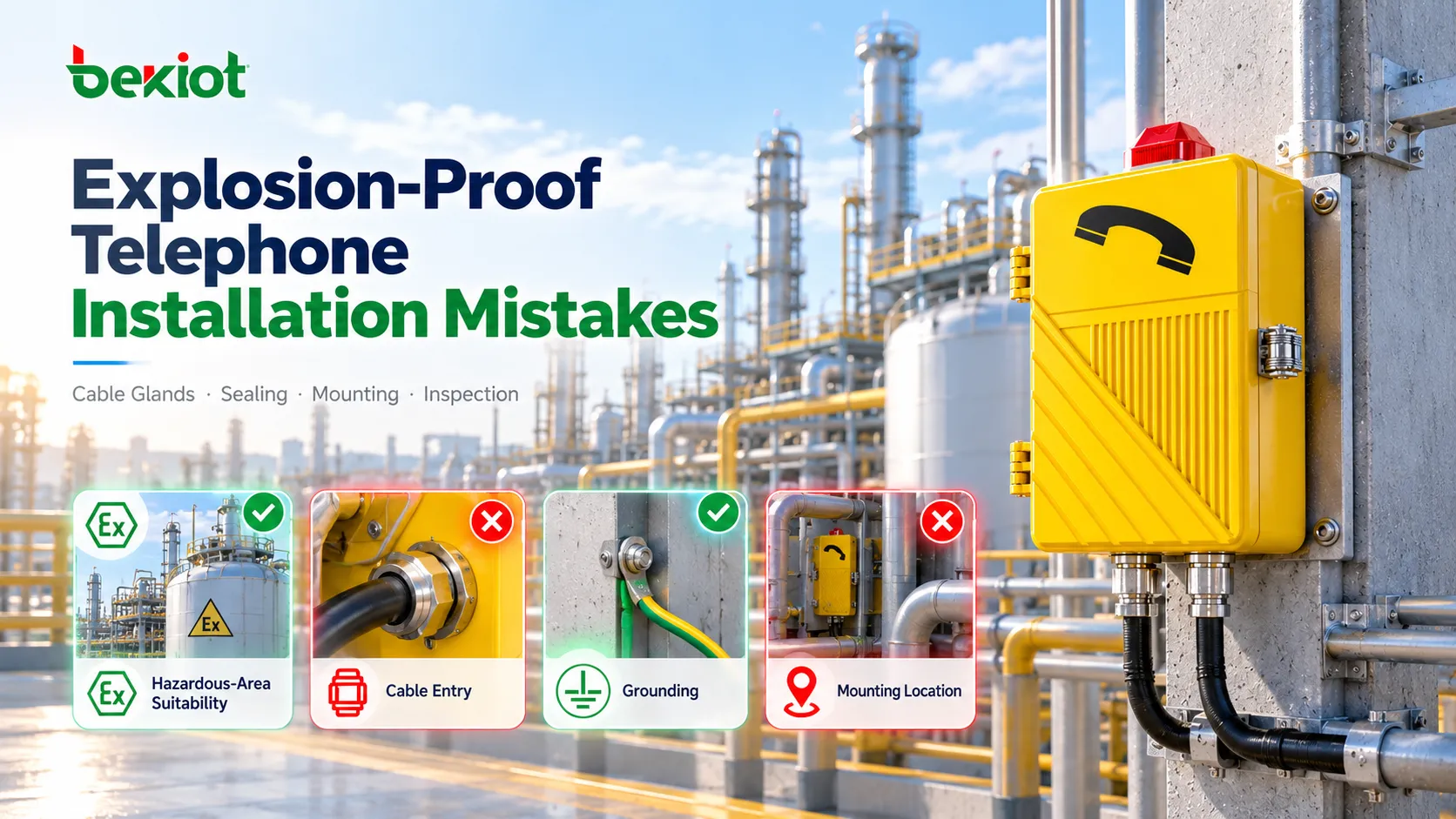
Do not assume that a similar-sized bolt, an industrial gland or an added sealant maintains the original arrangement. Enclosure opening and repair require the applicable isolation, atmospheric controls and site procedures. More field examples are covered in common explosion-proof telephone installation mistakes.
For Ex i, Preserve the Assessed Circuit
Changing a cable, barrier, isolator or connected device can alter the system assessment. In an entity-parameter approach, source output limits Uo, Io and Po are checked against equipment input limits Ui, Ii and Pi. Equipment and cable capacitance and inductance must also fit the permitted system limits and any combined restrictions. Matching nominal voltage alone is insufficient.
Keep the cable type, length, electrical parameters, separation and identification consistent with the documented design. Use the specified earthing arrangement: an intrinsically safe system does not have one universal grounding method. Any calculation or configuration change needs competent review against the relevant documentation.
Intrinsic safety may allow particular energized maintenance activities, but it does not grant unrestricted live working. The permitted task, connections, test instrument, certificate conditions and site work controls still govern the activity.
Choose the Complete Communication Arrangement
A plant can reasonably use fixed flameproof telephones alongside intrinsically safe radios and dispatch equipment in a non-hazardous location. The communications platform can connect different types of terminal without making them share the same protection concept. Each field device and interface must remain suitable for its own location and connection.
Before approving a terminal, record the hazard type, location classification, required equipment protection level, gas or dust group, temperature requirement, ambient conditions and locally accepted approval route. Then compare the actual model, certificate, accessories and communications functions with those requirements. This keeps the decision focused on both ignition protection and a usable communications point.
The relevant IEC references include IEC 60079-0, -1, -11, -14, -25 and -31. Standards change; the certificate's stated editions and the project's adopted requirements need to be reviewed together. A newly published edition alone does not determine the acceptability of an existing product or installation.
FAQs
Can an analog telephone cable be reused when upgrading to a SIP terminal?
Do not infer suitability from the old telephone's protection concept. Review the proposed SIP interface, power arrangement, cable characteristics and condition, route and entry compatibility. A cable accepted for the existing analog circuit may not meet the replacement system's transmission or installation requirements. Document the reuse assessment before ordering the new terminal.
How should quotations for Ex d and Ex i terminals be compared?
Compare complete installed arrangements delivering the same communication task. Include required accessories, associated apparatus where applicable, mounting and cabling work, commissioning, spares and maintenance access. Comparing a fixed alarm telephone with a portable radio on unit price alone does not establish which arrangement meets the operational requirement or costs less over its service life.
What if the quoted model suffix does not appear clearly on the certificate?
Ask for traceable documentation linking the exact quoted variant to the certificate scope and applicable conditions. Resolve differences between the quotation, certificate schedule and installation instructions before accepting a substitution. A shared product-family name or similar enclosure is insufficient evidence that the quoted functions and interfaces are covered.