

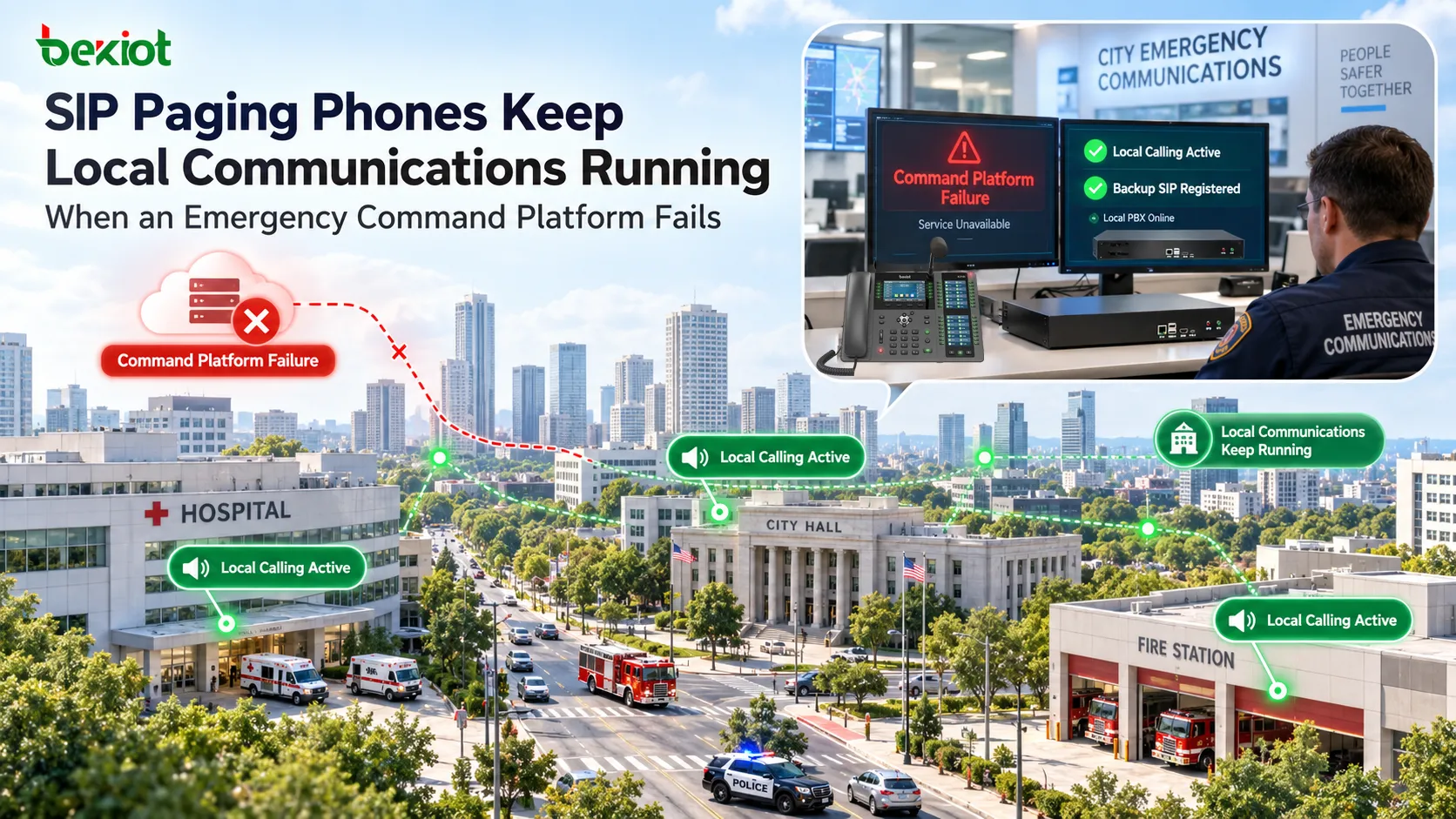
A fixed SIP paging phone can preserve a direct voice interface when dispatch software is unavailable, provided its remaining call-control, network, media and power dependencies still work. The phone alone does not create an independent emergency network. Local continuity must be designed and tested for specific failures.
Operators may need to reach a duty room, incident commander, paging zone, radio users or an external organization before the main platform recovers. Supported hands-free audio, DSS keys, hotlines and external interfaces can help, but group calling, paging and radio access depend on the terminal, service and integration selected.
Identify what has actually failed
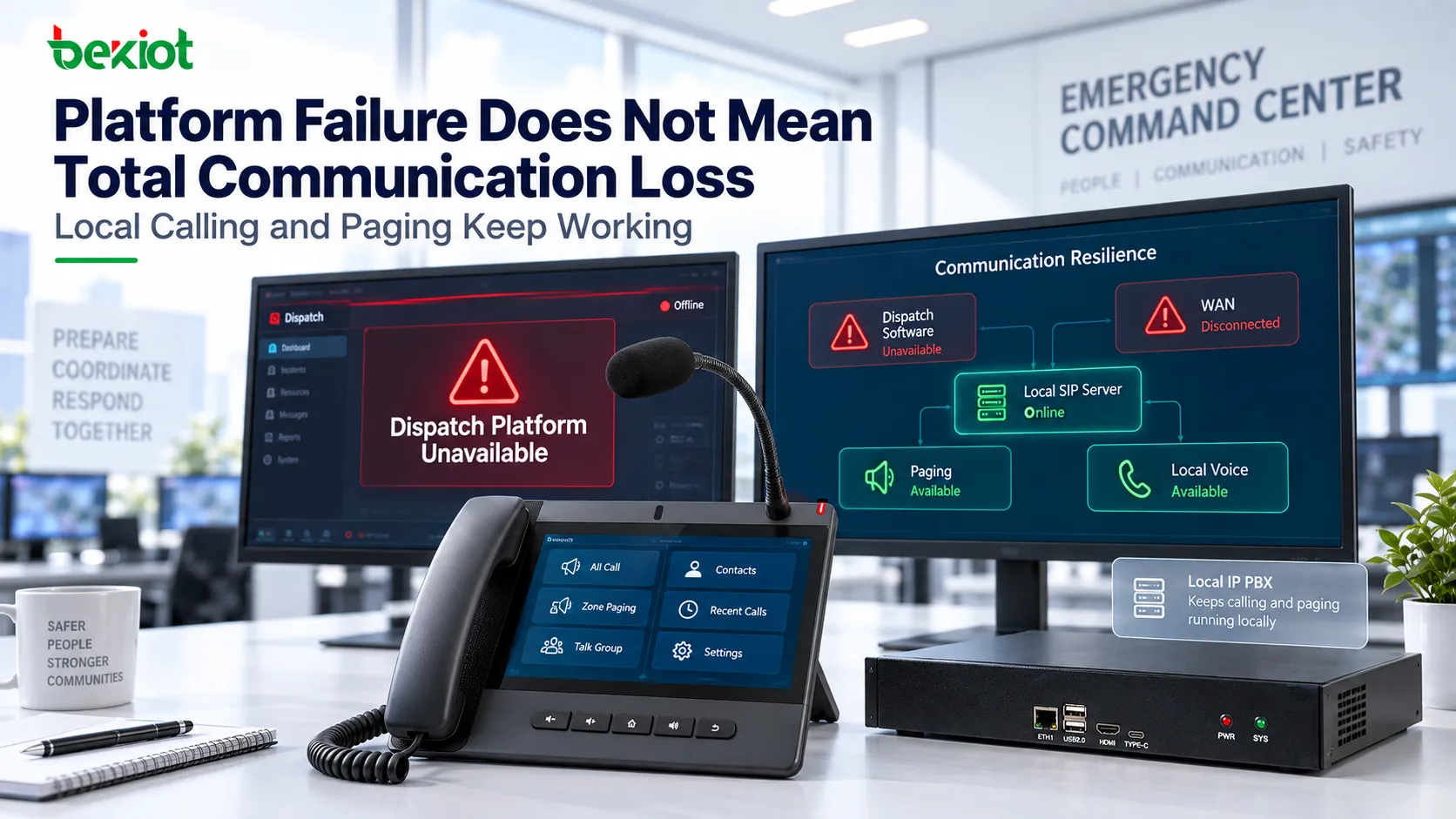
“Platform down” can mean a frozen dispatch interface, a database failure, lost SIP call control, a WAN outage or a power loss. Dispatch applications, IP PBX services, SBCs, directories, paging, recording and gateways may run separately or share one node. Draw the actual dependencies before choosing a backup.
If only the dispatch workstation fails, fixed phones may still call through the working SIP core. If registration and routing fail on the same central node, those phones need an alternate route. Two virtual SIP servers sharing one host, switch, uplink or UPS remain exposed to those common failures.
Define the minimum service and its failure boundaries
Start with calls between critical roles, fixed hotlines, necessary paging, radio access and essential external calling. Decide whether recording and conferencing must also survive. GIS, video, historical data, dynamic directories and complex incident workflows may be unavailable in an agreed degraded mode; mandatory functions cannot simply be omitted.
Application and WAN failures
Separating basic SIP call control from dispatch applications can preserve calling after an application fault. A local IP PBX or survivability node can support on-site numbering during WAN loss only if accounts, authentication, dial plans and necessary services are locally available. A local node that still needs an unreachable cloud database is not a complete fallback.
SIP node, LAN and power failures
A backup Registrar or call-control service addresses supported server failures; it does not repair a broken access switch or power circuit. LAN continuity requires viable alternate network paths or another communication method. Power continuity requires backed-up supplies for the complete critical path, including PoE switches, servers, phones and gateways.
Define acceptable service interruption and backup operating time for the site’s risk and responsibilities. Assess aggregation switches, fiber links, DNS, DHCP where needed, time services, virtualization hosts and shared storage. Redundancy is limited by the dependencies that both paths still share.
Choose the appropriate fallback mechanism
Local survivability and redundant registration
For critical sites, keep essential call control on site or provide an independently reachable alternate service. Depending on supported behavior, endpoints may use primary and backup servers, simultaneous accounts, DNS-based server discovery or a server cluster. RFC 3263 describes SIP server discovery and retry behavior; it does not guarantee an endpoint’s complete failover design.
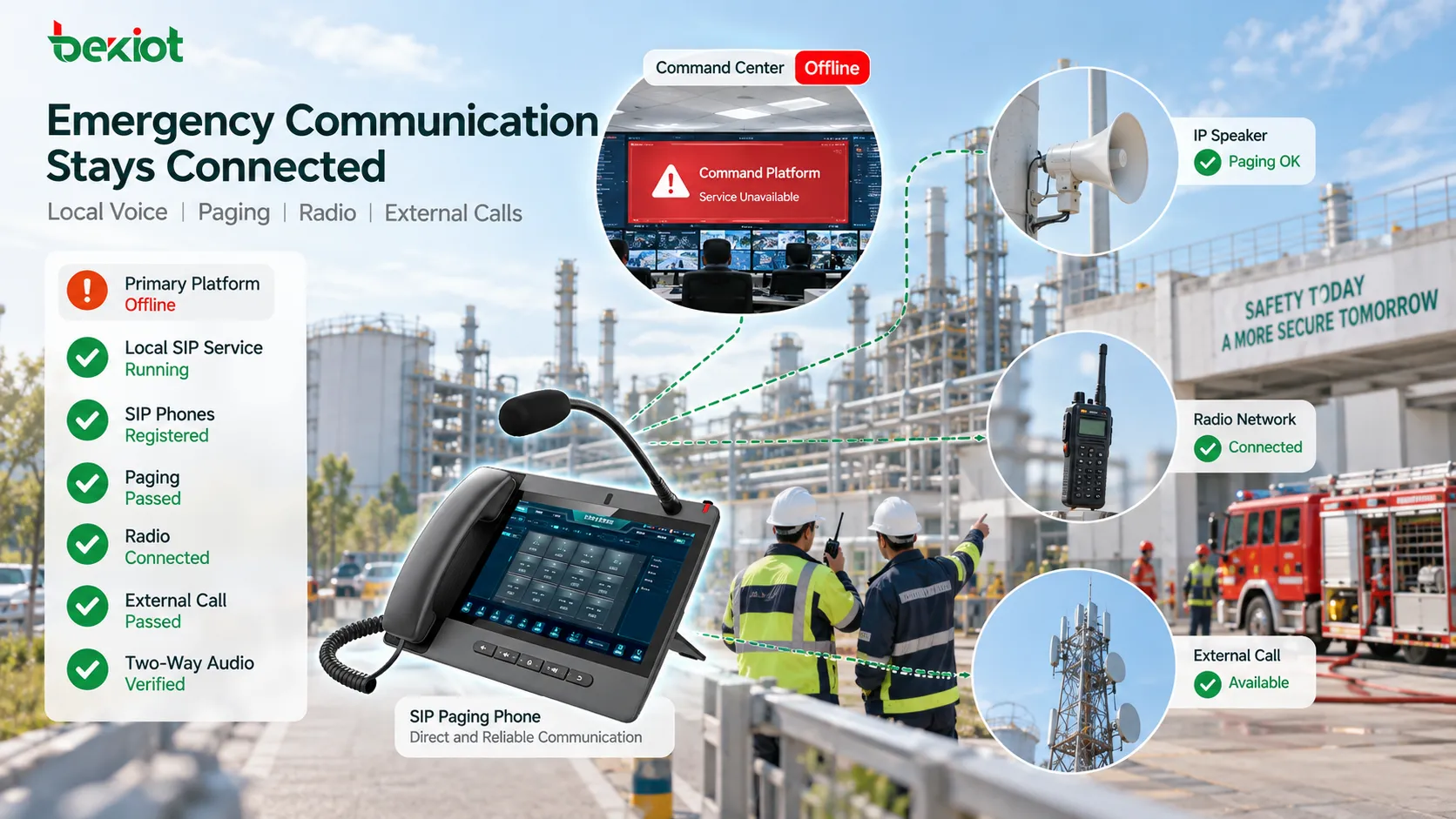
Verify failure detection, registration delay, new-call availability, route permissions, incoming calls and failback. An alternate registration is not proof that destinations, gateways or media are reachable. Existing calls may drop or continue depending on signaling and media anchoring; do not promise uninterrupted calls without testing the actual topology.
Related solution: IP telephony dispatch for command and control centers.
Direct-IP calling is a separate, limited option
Some endpoints can call a configured SIP URI or IP address without registering with the failed server. Both ends must support and allow this mode, with stable addressing, compatible codecs, reachable SIP and RTP, and an approved security policy. DNS remains a dependency if names are used. It may bypass the Registrar but not the LAN, power or destination terminal.
Direct-IP dialing does not automatically preserve short extension numbers, inbound routing, emergency priority, recording, conferences or gateway access. Preconfigure and label any approved destinations; asking an operator to type unfamiliar IP addresses during an incident is a weak operational plan.
Local multicast paging is not ordinary SIP calling
Where explicitly supported, a phone or paging source may send audio directly to a configured multicast group without central call control. Receivers, codecs, group addresses, ports, permissions and priority behavior must match. Switching, IGMP handling, VLAN boundaries and multicast routing where required must remain operational.
This can preserve a specific announcement path during a server outage, but it is not automatically two-way calling or confirmed receipt. It does not bypass failed switches, loudspeaker power or an unavailable paging source. Test reception in every required zone and define how competing announcements are handled.
Keep paging, radio and external routes usable
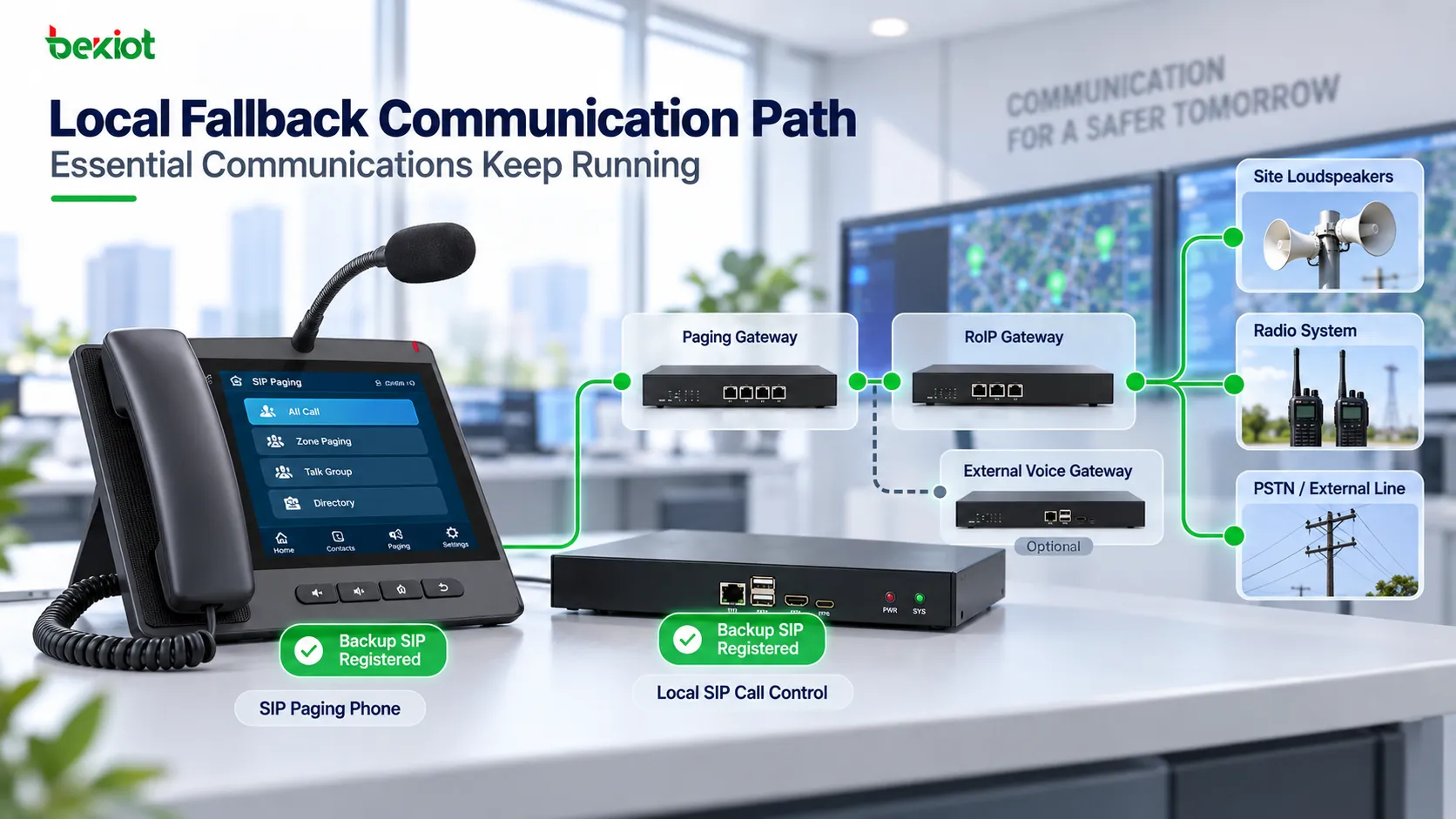
A fixed short number may reach a SIP paging gateway, a RoIP gateway or a voice gateway only when call routing and the selected gateway remain available. Paging also needs the amplifier, speaker circuits or IP receivers and their power. RoIP also needs compatible radio audio, push-to-talk control, the radio network and any required authorization.
DMR, PDT, TETRA and PoC are different systems; a telephone does not natively provide every radio interface. External access through an FXO gateway, SIP Trunk or other route still depends on the line or carrier and its infrastructure. Check codec, DTMF and half-duplex behavior where applicable. A gateway cannot make an unavailable downstream service work.
Make fallback familiar to operators
Retain the usual short numbers and fixed DSS keys for the duty supervisor, fire control, paging, radio and essential external access wherever the architecture permits. Store critical destinations so they remain accessible without the failed directory. Hotline or Off-Hook Auto Dial should reflect assigned duties and accidental-activation risk rather than being enabled everywhere.
Show degraded status and remaining services clearly where the terminal supports it, and provide a simple operating procedure when it does not. A green registration icon cannot describe the availability of every service. Labels and drills should let operators place the next critical call without diagnosing the system themselves.
Hands-free and amplified audio can help nearby control-room personnel hear urgent information. Verify feedback, ambient noise, privacy and interference between adjacent positions. Simplicity only helps when the selected keys, audio paths and answering roles actually remain operational.
Protect the complete network and power path
Redundant SIP servers do little when one PoE switch powers every critical phone. Evaluate access and core switching, physically separate uplinks where justified, gateway supplies and endpoint connectivity. A single-port phone does not acquire two independent network connections merely because the core is redundant.
Calculate the full critical load and validate UPS runtime under that load, including conversion losses and the required operating reserve. A nominal backup-time label is not an acceptance result. For severe LAN failures or extended outages, consider radio, analog hotlines, satellite or another method with a genuinely different failure domain.
Accept real communication, then test controlled failures
Power, IP reachability and SIP registration are different observations. REGISTER creates or updates contact bindings; it does not establish a voice session. Calls can signal successfully while RTP is blocked by routing, NAT, firewall policy or media configuration. Codec compatibility and the microphones, loudspeakers and far-end equipment also matter.
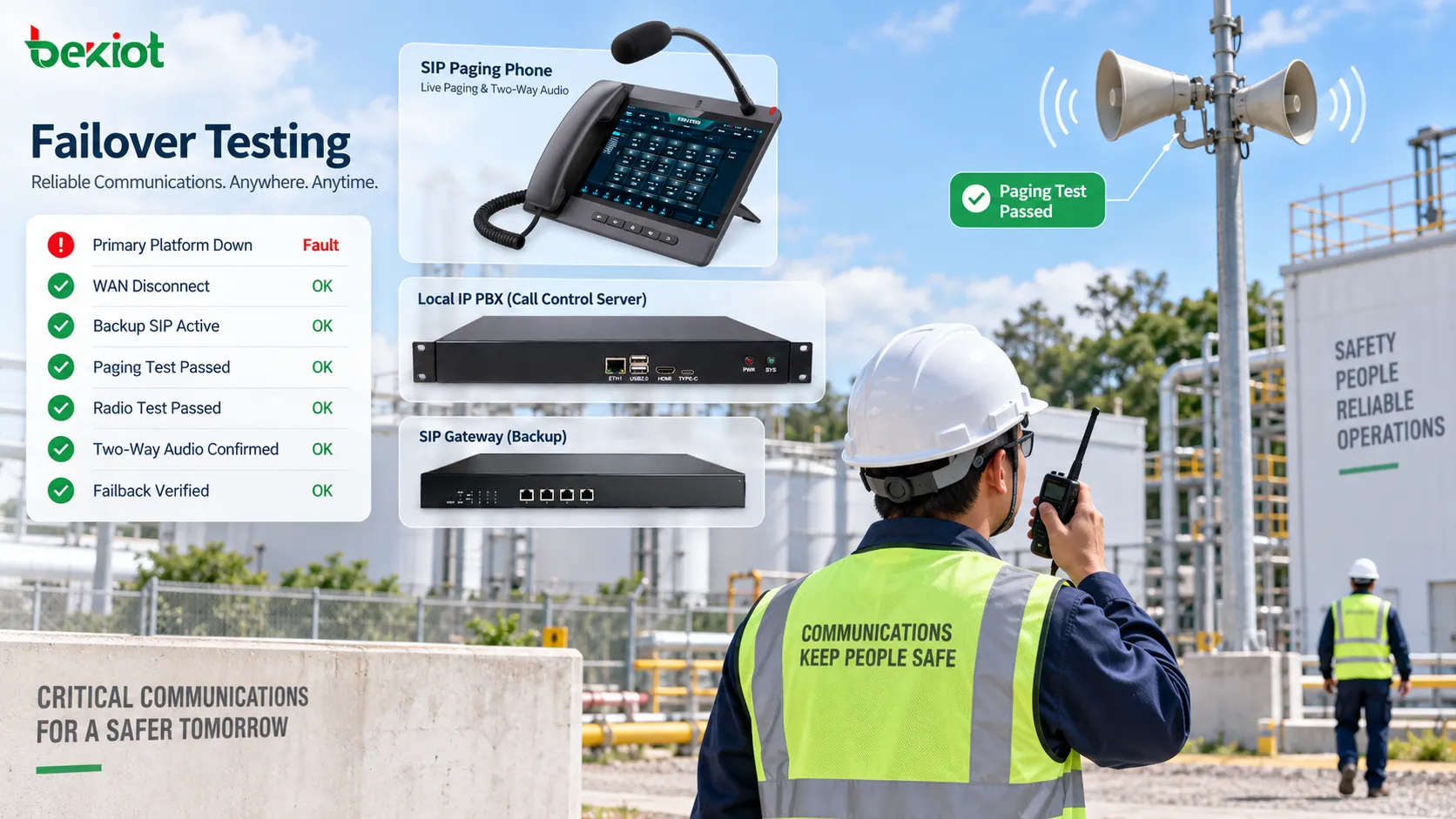
Under approved maintenance and safety procedures, record a normal baseline, then separately stop the dispatch application, isolate the WAN, stop the primary SIP node and interrupt selected network paths. Simulate utility-power loss where authorized. State exactly which services should survive each test and avoid disrupting live incident response.
For each condition, measure detection and recovery, place inbound and outbound calls to critical positions, confirm two-way audio, test fixed hotlines, verify field paging reception, and check radio and necessary external calls. Verify recording if required. Log endpoint identities, routes, alarms, timelines and any manual steps.
Restore the primary services and observe failback as carefully as failover. Check duplicate registrations, stale routes, missing inbound calls and endpoints that remain on the backup. Recheck priority, identification and recording after recovery. A successful normal call or backup registration alone cannot establish fallback readiness.
FAQs
Must recording continue during fallback?
That depends on operational and applicable compliance requirements. If mandatory, verify an available recording path or independent local recording and confirm that media reaches it in every required failure state.
Does every branch need local call control?
No. Decide from site criticality, WAN dependence, endpoint count and acceptable interruption. Central high availability may meet some needs, but it cannot by itself restore a disconnected branch’s WAN.
Must primary and backup SIP servers come from the same supplier?
No absolute protocol rule requires it. Test registration, dial routing, feature codes, subscriptions, media and recovery across the actual products. Shared SIP support does not prove seamless redundancy.
When is a separate communication method necessary?
When required scenarios include failures that disable the whole local IP path, prolonged power loss or wider infrastructure disruption, evaluate an alternative with different network, power and operational dependencies.
Becke Telcom provides SIP paging phones and paging, dispatch, RoIP and voice-gateway integration equipment. A project can combine these components for agreed fallback services only after verifying model capabilities, independent dependencies and complete call paths under the specified failures.
Technical references
RFC 3261: SIP signaling and registration.