

A rugged VoIP terminal may register successfully to a server yet fail an operational task: a push-to-talk button may control the wrong application, a remote caller may receive no audio, or the device may not recover its calling service after a power interruption. Field acceptance must therefore test the required communication workflow on the exact hardware and software configuration.
The useful purchasing question is not whether a terminal carries a broad “mission-critical” label. It is whether documented capabilities and repeatable tests support the role assigned to it. Keep the terminal's native functions separate from functions supplied by an IP PBX, dispatch application, radio gateway or wider network.
Verify the Call and Push-to-Talk Workflows
RFC 3261 defines SIP as session-control signaling. Successful registration or call setup is not proof of a working media path, multicast paging, radio interoperability or a particular emergency priority function.
Test incoming and outgoing calls using the intended server, network path, codecs and security configuration. Confirm two-way audio, call release and any required transfer or DTMF behavior. Where the deployment uses an SBC, VPN or routed site connection, include that path in the test. A call made across a laboratory switch does not establish performance across the production network.
A physical PTT button also needs an explicit functional definition. It might activate an application, request permission to transmit in a managed group, mute a local microphone, or drive a supported gateway interface. Those functions are not interchangeable. For a radio connection, identify the gateway, radio interface and transmit/receive control behavior required by the design.
| Requested behavior | Acceptance evidence |
|---|---|
| One-button calling | The configured button reaches the intended staffed destination and follows the agreed unanswered-call behavior. |
| PTT group communication | Button press and release control the intended group; busy, denied and interrupted transmission states are clear to the user. |
| Radio interconnection | The documented terminal-to-platform-to-gateway path passes speech and control correctly in both directions. |
| Emergency priority | The actual endpoint and platform configuration produces the specified priority behavior under competing traffic. |
Record which functions belong to the terminal and which require another system. Do not turn a successful integration demonstration into a claim that every terminal of the same general category supports those features natively.
Test Audio, Power and Recovery in the Intended Configuration
Audio acceptance should include the intended handset, speakerphone or headset, representative background noise, and normal user protective equipment where relevant. Check intelligibility at both ends. A loudspeaker output figure measured at a stated distance does not by itself establish speech intelligibility at an industrial site.
For a PoE installation, confirm the terminal's documented power requirements, the switch or injector's supported power type, the available port and system budget, and the actual cabling. Include any required accessories or peak operating load. An Ethernet connector does not prove PoE support, and a drawing labelled with a PoE standard is not product evidence.
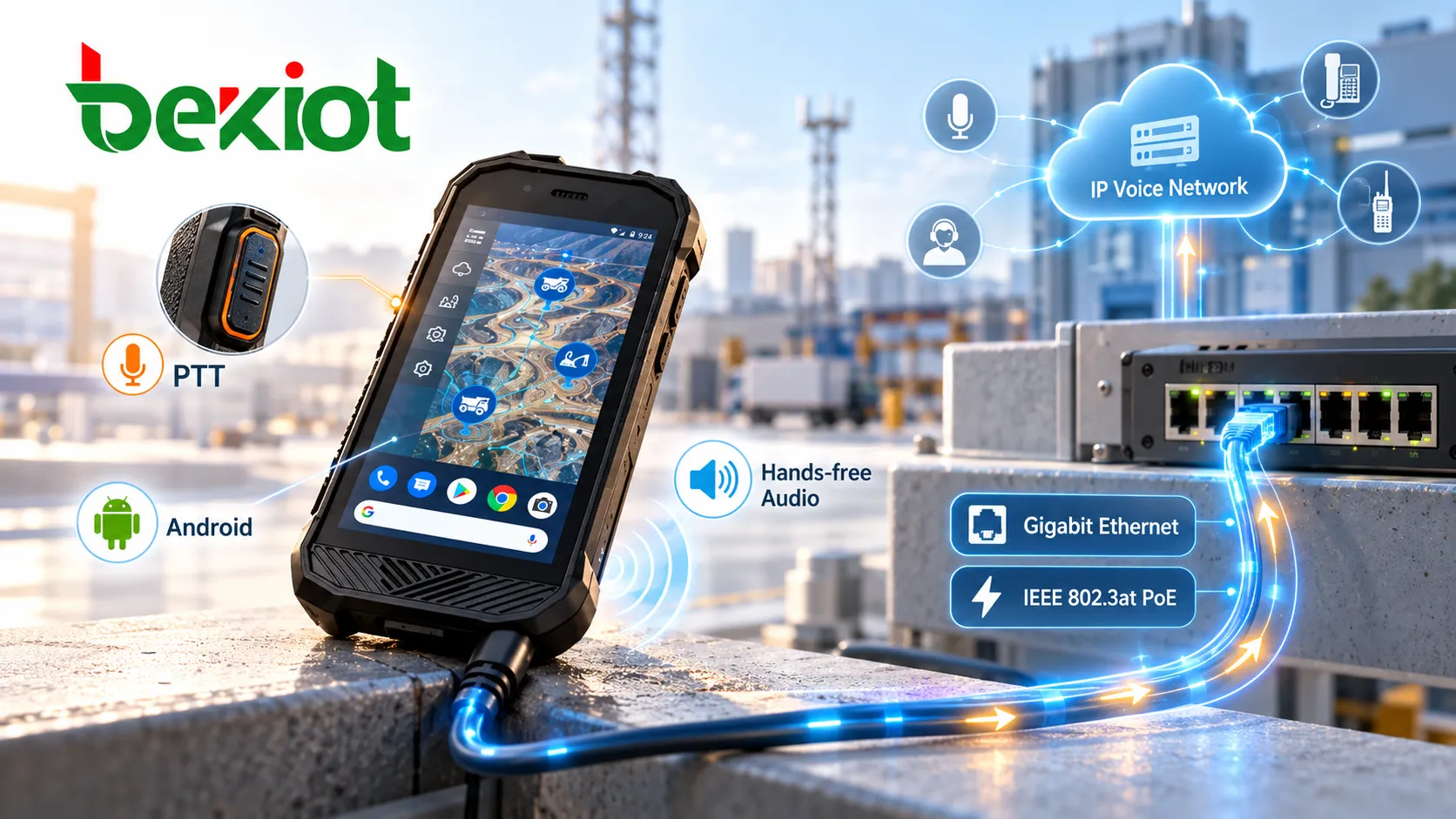
In a controlled acceptance test, interrupt and restore the relevant power or network service. Observe reboot behavior, time synchronization, registration recovery, application start-up and recovery of the assigned call buttons. Record whether a user must intervene. Where backup operation is required, test the complete path, including switches, servers and gateways, against the project's specified duration.
Network redundancy, local battery capacity and application failover solve different problems. Identify which failure each measure covers and which dependencies remain. Avoid calling the complete system resilient solely because its terminal has a durable enclosure.
Check Environmental Evidence and Software Support Separately
Match environmental evidence to the installed configuration. Review the exact model, tested conditions, pass criteria, mounting arrangement, connector protection and permitted accessories. A general ruggedness claim does not establish resistance to every combination of temperature, water, dust, salt, vibration or impact.
A laboratory test report also needs its scope interpreted correctly. Do not present a selected test method as proof of suitability for every military, marine or industrial application. An ingress-protection rating is not an explosion-protection approval; deployment in a classified hazardous area requires the appropriate assessment and evidence for that location.
Software support is a separate purchasing requirement. Obtain the supported firmware and operating-system versions, security-update policy, support period, application compatibility and recovery method. A named operating-system version says little about its current patch status or the supplier's ability to maintain the full device image.
For terminals connected to an operational technology environment, NIST SP 800-82 Revision 3 provides a security framework that accounts for operational performance, reliability and safety. Apply security controls to the actual architecture: define administration access, credentials, network access, update responsibility and recovery procedures with the system owner.
Make Acceptance Results Traceable to the Delivered Equipment
Use a test record that identifies the terminal model and hardware revision, firmware, application versions, server or platform versions, accessories and network configuration. Record the test condition, expected behavior, observed result and unresolved limitation for each requirement.
Separate a failed test from an untested feature. If a demonstration depends on a forthcoming software release, customized gateway or engineering change, record that dependency and the party responsible for delivering it. Final acceptance should refer to the supplied configuration, not an unspecified future capability.
Retain the accepted configuration and recovery instructions for maintenance. Recheck affected workflows after a firmware, application, server or network change; previous results do not automatically transfer to a new combination.
For fixed field calling points, the industrial SIP phone overview describes the device category and typical architecture. Terminal evaluation should then narrow to the required calling task, operating environment and evidence needed for the specific project.