

Thông tin ngành
2026-11-02 14:33:44

Quy trình hủy đăng ký do UE khởi tạo trong 5GC

Hủy đăng ký do UE khởi tạo trong 5GC bao gồm phạm vi yêu cầu, dọn dẹp SMF/UPF và chính sách có điều kiện, hủy đăng ký thông thường so với tắt nguồn, T3521 và kiểm tra báo hiệu cho ngữ cảnh được giải phóng hoặc giữ lại.

Becke Telcom

Quy trình hủy đăng ký do UE khởi tạo trong 5GC

An RRC Release does not prove that a UE has deregistered. A registered UE can release its access signaling connection while the AMF retains registration context and the SMF retains PDU Sessions. UE-initiated deregistration instead begins with a NAS Deregistration Request and ends the registration for the indicated access.

For trace analysis, follow the request scope, applicable session and policy cleanup, and the expected NAS response. The AMF, SMF, UPF, PCF and UDM hold different parts of this state; they do not all delete every UE record at the same instant.

Read the deregistration scope first

The UE sends Deregistration Request toward the AMF using its 5G-GUTI. Check Deregistration type, including the Switch off indication, and Access Type. The target can be 3GPP access, non-3GPP access, or both when the two accesses are served by the same AMF. The access carrying the request need not be the access being removed.

At NAS encoding level, access type is part of the de-registration type information element, not a separate field with the illustrative IEI shown below. Identity and integrity protection must be checked against the actual NAS context; an unprotected or unverifiable request can require security handling before cleanup.
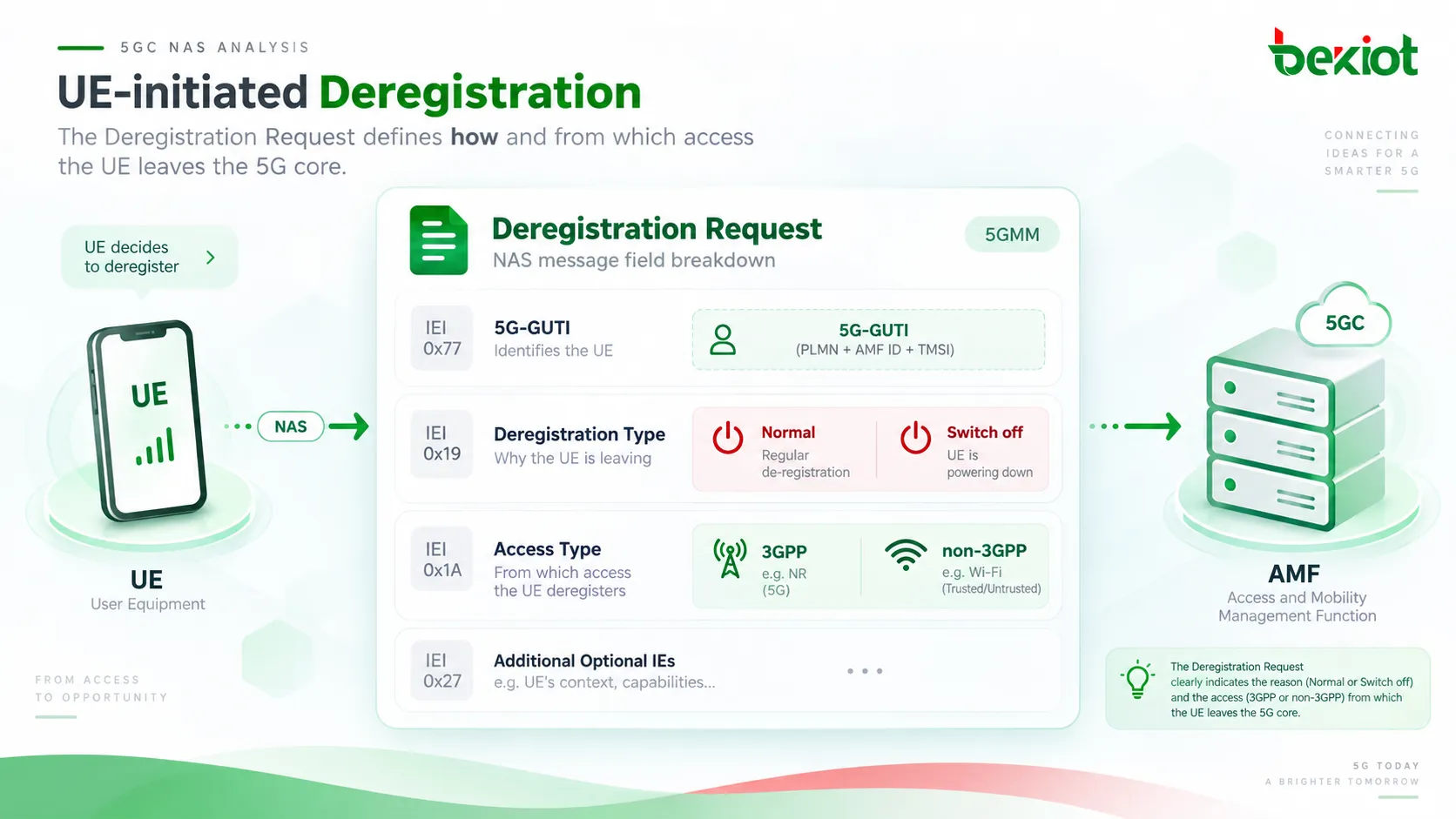
Illustration of a UE sending Deregistration Request to the AMF, highlighting identity, deregistration type and access scope.
Illustration of a UE sending Deregistration Request to the AMF, highlighting identity, deregistration type and access scope

Release the PDU Sessions that belong to the target access

If no PDU Session exists over the target access, the session-release steps are skipped. Otherwise, the AMF sends Nsmf_PDUSession_ReleaseSMContext to the relevant SMF for each affected session. A standalone PDU Session Release removes a data session while registration can remain valid; deregistration has a wider scope. For a multi-access (MA) PDU Session with user-plane resources on both accesses, deregistration from one access releases only that access's user-plane resources; the session can remain on the other access.

The SMF releases allocated session resources, such as the IP address or prefix, and requests N4 session release from the applicable UPFs. On N4, PFCP Session Deletion Request and PFCP Session Deletion Response identify the deletion exchange. Successful deletion removes that PFCP session and its associated rules, including applicable PDRs, FARs, QERs and URRs, and releases associated tunnel resources.

The SMF returns the SM-context release response. In home-routed roaming, V-SMF and H-SMF coordination also applies. The reference flow has conditional ordering: when secondary RAT usage reporting is required, the AMF performs the NAS acceptance and access release first, obtains the usage data, and then continues session and policy cleanup.
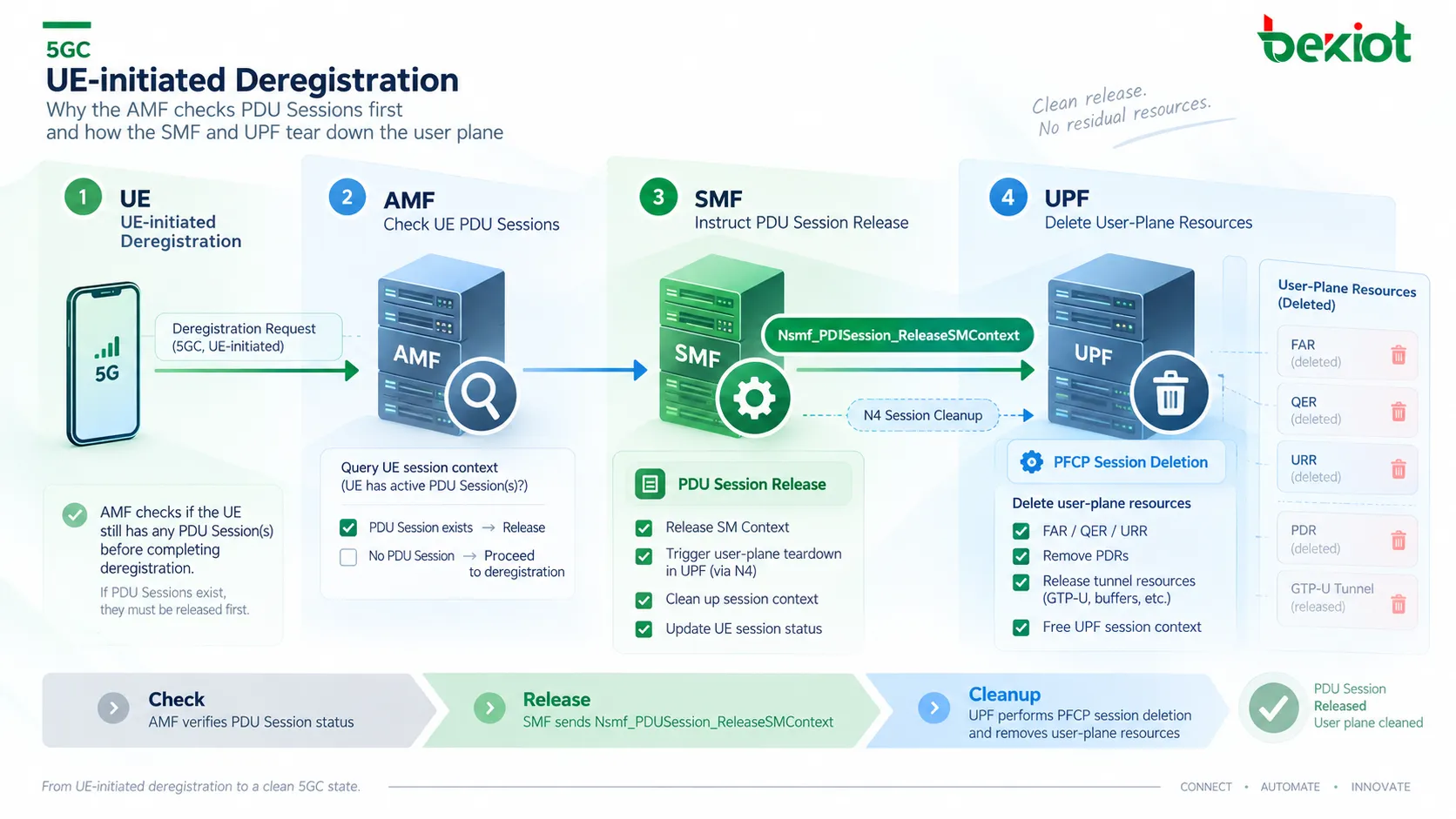
Illustration of UE, AMF, SMF and UPF roles in deregistration and user-plane resource release.
Illustration of UE, AMF, SMF and UPF roles in deregistration and user-plane resource release

Remove obsolete policy and UDM associations conditionally

If dynamic PCC applies, the SMF terminates the SM Policy Association, using Npcf_SMPolicyControl_Delete as applicable. For the last PDU Session that the SMF handles for the UE and the associated DNN and S-NSSAI, it uses Nudm_SDM_Unsubscribe and Nudm_UECM_Deregistration to remove the relevant subscription and SMF registration association in the UDM.

The AMF terminates existing AM Policy and UE Policy Associations when the UE is no longer registered over any access. Do not infer that the subscriber profile, historical charging data or every UDM record must be erased. Another registered access or session can still require context; verify the exact association and scope.
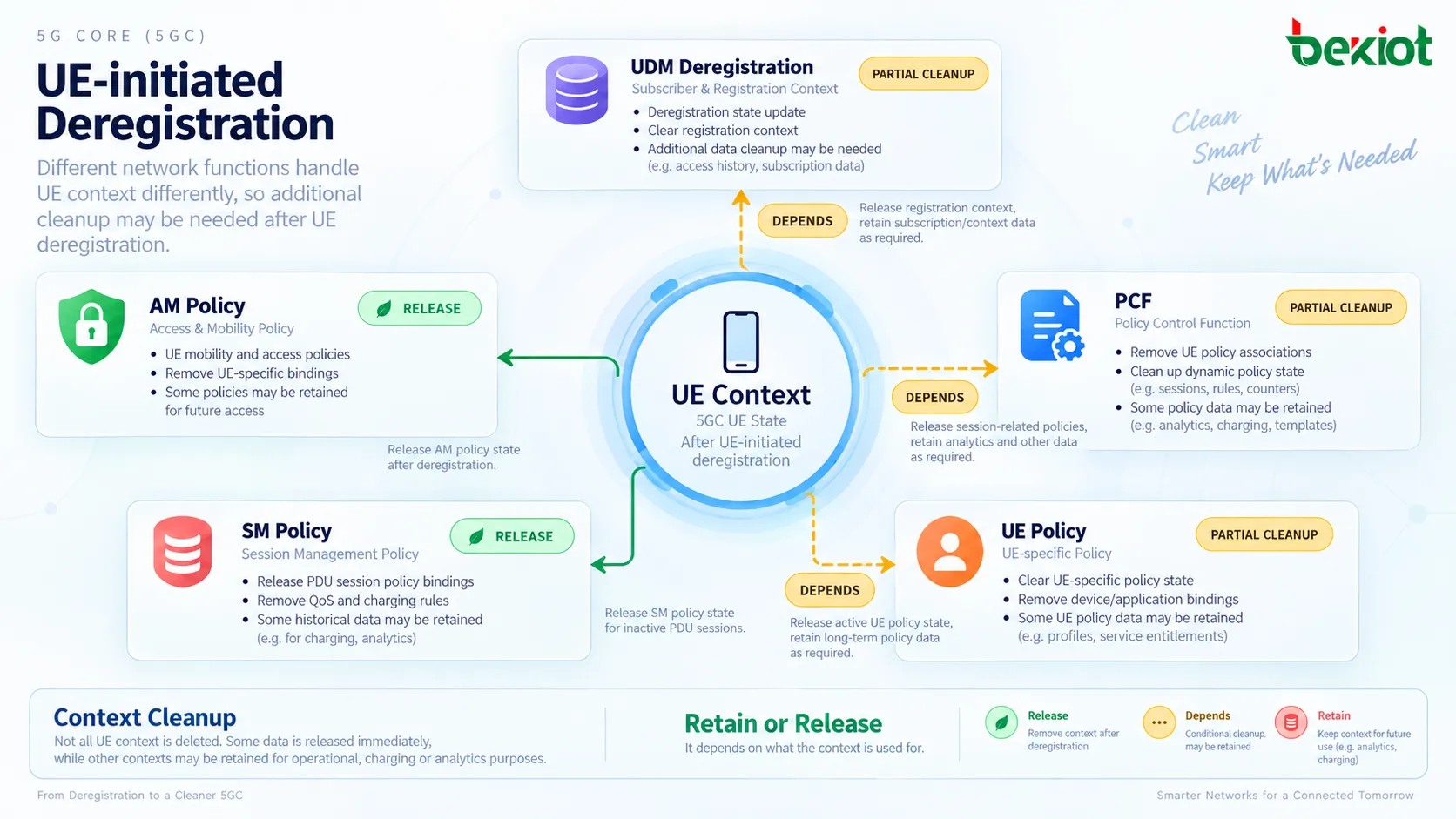
Diagram grouping AM Policy, SM Policy, UE Policy, PCF and UDM cleanup around the UE context.
Diagram grouping AM Policy, SM Policy, UE Policy, PCF and UDM cleanup around the UE context

Normal de-registration and Switch off end differently

For Normal de-registration, the UE expects Deregistration Accept and uses T3521 to supervise the response, following the specified retry and failure rules if it expires. The AMF also releases the relevant N2 signaling connection when it exists, for NG-RAN or the applicable non-3GPP access gateway.

For Switch off, the AMF does not send Deregistration Accept. The UE does not wait for that confirmation before shutdown. An absent response in this case is expected behavior, not evidence by itself of failed deregistration.

A request may never reach the AMF after sudden power loss or loss of coverage. That abnormal disappearance is handled by network reachability supervision and, when its conditions are met, implicit deregistration. It is distinct from a successfully received switch-off request.

A practical trace checklist

  1. Confirm UE-to-AMF direction, the 5G-GUTI, integrity result, deregistration type and target access.

  2. Establish whether affected PDU Sessions and N4 contexts existed before looking for release messages.

  3. Correlate AMF-to-SMF, SMF-to-UPF and policy/UDM transactions by UE and session identity; check responses and retained state.

  4. Expect NAS acceptance only for the applicable non-switch-off case, and account for access release and conditional usage-reporting order.

FAQs

Is switch-off request delivery guaranteed?

No. Sudden loss of power or radio coverage can prevent delivery. A missing request does not prove that the AMF has already removed registration state.

Does every deregistration contain PFCP deletion?

No. With no relevant established PDU Session or N4 context, there is nothing corresponding to delete. Investigate the prior session state before classifying missing PFCP messages as a fault.

Can another access remain registered?

Yes. Deregistration can target one access. Check the indicated scope before expecting AM Policy or UE Policy Association termination or removal of all session state.

How does network-initiated deregistration differ?

The NAS request travels from AMF to UE, or is absent for implicit deregistration. The trigger and expected response differ, even though some backend cleanup steps overlap.

Related procedures and standards

For the opposite trigger direction, see network-initiated deregistration. To understand idle reachability before implicit cleanup, see periodic registration update.

The procedure above follows 3GPP TS 23.502 clause 4.2.2.3.2, NAS behavior in 3GPP TS 24.501 clause 5.5.2.2 and timer tables, and PFCP deletion in 3GPP TS 29.244 clause 6.3.4. Match the release and supported features to the deployment being analyzed.


Sản phẩm đề xuất
Danh mục
dịch vụ khách hàng Điện thoại
We use cookie to improve your online experience. By continuing to browse this website, you agree to our use of cookie.

Cookies

This Cookie Policy explains how we use cookies and similar technologies when you access or use our website and related services. Please read this Policy together with our Terms and Conditions and Privacy Policy so that you understand how we collect, use, and protect information.

By continuing to access or use our Services, you acknowledge that cookies and similar technologies may be used as described in this Policy, subject to applicable law and your available choices.

Updates to This Cookie Policy

We may revise this Cookie Policy from time to time to reflect changes in legal requirements, technology, or our business practices. When we make updates, the revised version will be posted on this page and will become effective from the date of publication unless otherwise required by law.

Where required, we will provide additional notice or request your consent before applying material changes that affect your rights or choices.

What Are Cookies?

Cookies are small text files placed on your device when you visit a website or interact with certain online content. They help websites recognize your browser or device, remember your preferences, support essential functionality, and improve the overall user experience.

In this Cookie Policy, the term “cookies” also includes similar technologies such as pixels, tags, web beacons, and other tracking tools that perform comparable functions.

Why We Use Cookies

We use cookies to help our website function properly, remember user preferences, enhance website performance, understand how visitors interact with our pages, and support security, analytics, and marketing activities where permitted by law.

We use cookies to keep our website functional, secure, efficient, and more relevant to your browsing experience.

Categories of Cookies We Use

Strictly Necessary Cookies

These cookies are essential for the operation of the website and cannot be disabled in our systems where they are required to provide the service you request. They are typically set in response to actions such as setting privacy preferences, signing in, or submitting forms.

Without these cookies, certain parts of the website may not function correctly.

Functional Cookies

Functional cookies enable enhanced features and personalization, such as remembering your preferences, language settings, or previously selected options. These cookies may be set by us or by third-party providers whose services are integrated into our website.

If you disable these cookies, some services or features may not work as intended.

Performance and Analytics Cookies

These cookies help us understand how visitors use our website by collecting information such as traffic sources, page visits, navigation behavior, and general interaction patterns. In many cases, this information is aggregated and does not directly identify individual users.

We use this information to improve website performance, usability, and content relevance.

Targeting and Advertising Cookies

These cookies may be placed by our advertising or marketing partners to help deliver more relevant ads and measure the effectiveness of campaigns. They may use information about your browsing activity across different websites and services to build a profile of your interests.

These cookies generally do not store directly identifying personal information, but they may identify your browser or device.

First-Party and Third-Party Cookies

Some cookies are set directly by our website and are referred to as first-party cookies. Other cookies are set by third-party services, such as analytics providers, embedded content providers, or advertising partners, and are referred to as third-party cookies.

Third-party providers may use their own cookies in accordance with their own privacy and cookie policies.

Information Collected Through Cookies

Depending on the type of cookie used, the information collected may include browser type, device type, IP address, referring website, pages viewed, time spent on pages, clickstream behavior, and general usage patterns.

This information helps us maintain the website, improve performance, enhance security, and provide a better user experience.

Your Cookie Choices

You can control or disable cookies through your browser settings and, where available, through our cookie consent or preference management tools. Depending on your location, you may also have the right to accept or reject certain categories of cookies, especially those used for analytics, personalization, or advertising purposes.

Please note that blocking or deleting certain cookies may affect the availability, functionality, or performance of some parts of the website.

Restricting cookies may limit certain features and reduce the quality of your experience on the website.

Cookies in Mobile Applications

Where our mobile applications use cookie-like technologies, they are generally limited to those required for core functionality, security, and service delivery. Disabling these essential technologies may affect the normal operation of the application.

We do not use essential mobile application cookies to store unnecessary personal information.

How to Manage Cookies

Most web browsers allow you to manage cookies through browser settings. You can usually choose to block, delete, or receive alerts before cookies are stored. Because browser controls vary, please refer to your browser provider’s support documentation for details on how to manage cookie settings.

Contact Us

If you have any questions about this Cookie Policy or our use of cookies and similar technologies, please contact us at support@becke.cc .