

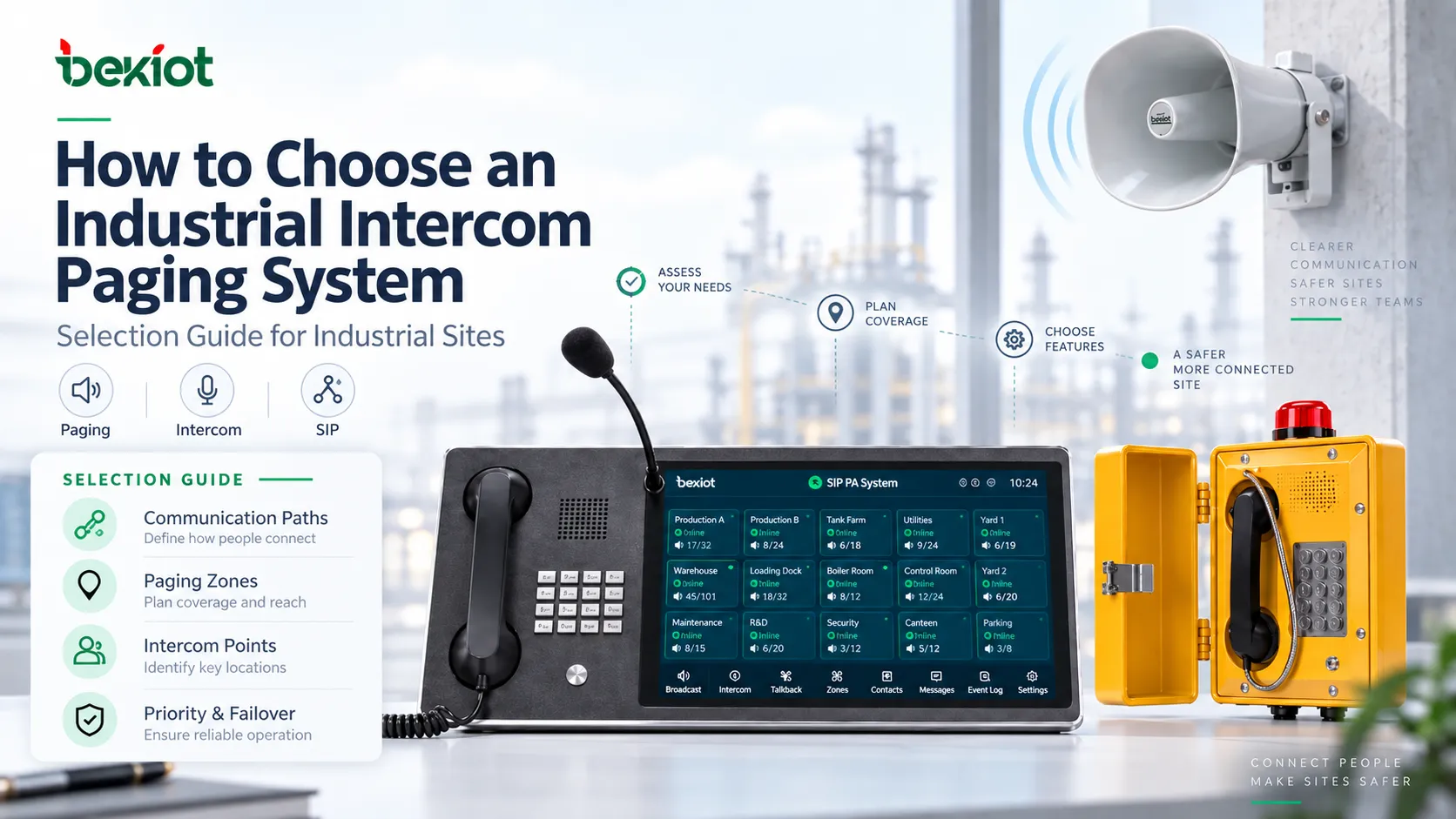
An industrial site needs both area announcements and a practical way for workers to reply. Plan paging and intercom as complementary functions: loudspeaker coverage reaches an area, while an intercom or telephone gives a person a return path. Start with operating tasks before selecting equipment.
Map communication paths before equipment
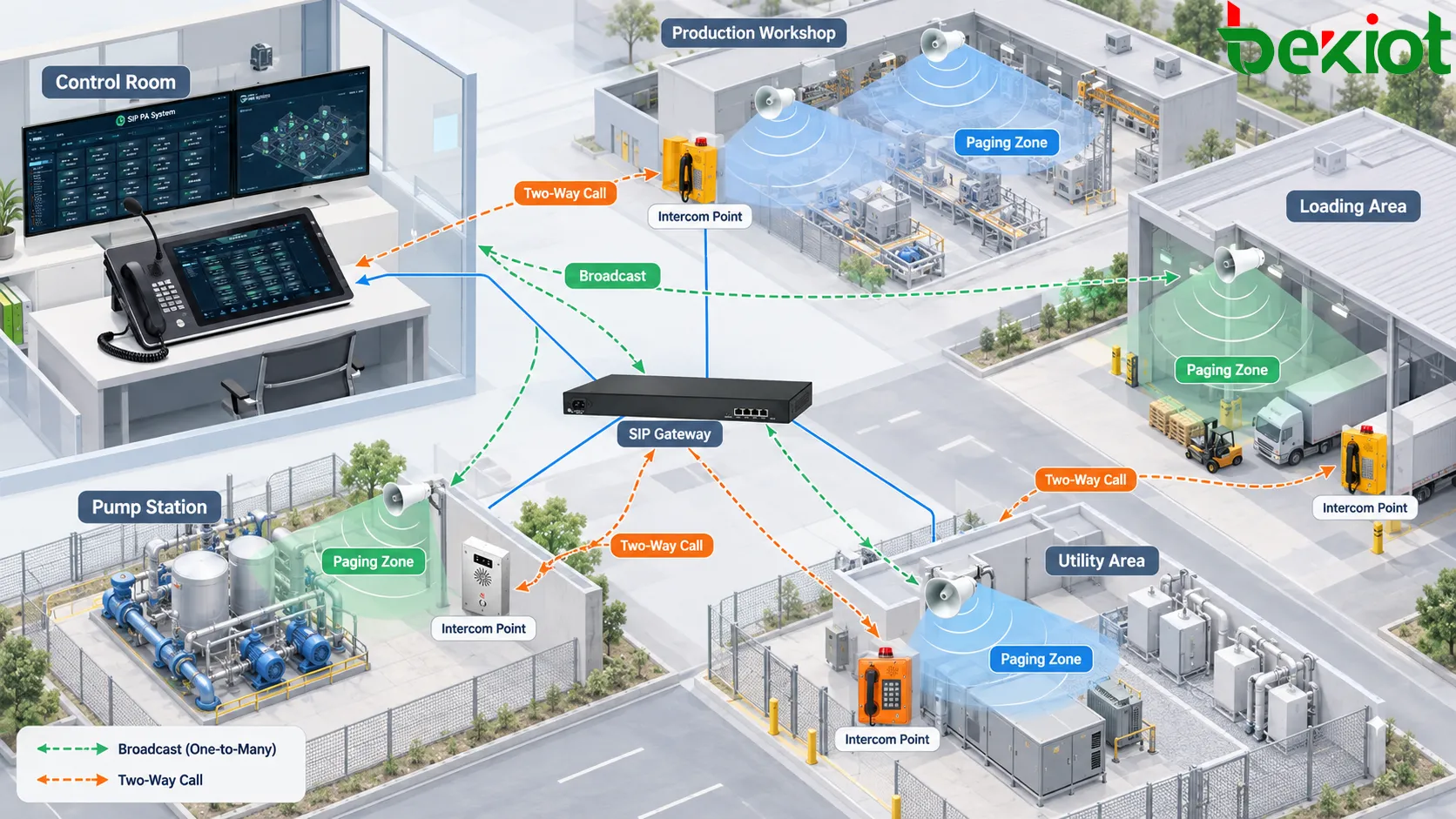
For each task, record the caller or trigger, destination, need for a reply, operator and fallback route. Include control-room calls to individual stations, single-zone and multi-zone pages, field assistance, one-button emergency calls, supervisor announcements and alarm-triggered messages. A warehouse announcement is one-to-many; a maintenance conversation needs audio in both directions.
Plan paging zones separately from intercom access points. A long workshop might have 1 paging zone, 6 horn speakers and 3 field intercoms; these are illustrative quantities, not a sizing rule. Several zones may share one operator, who still needs a reliable caller location display. Place call points where people work or seek help, rather than assigning one intercom to every speaker.
Match endpoints and interfaces to their roles
| Endpoint | Selection purpose |
|---|---|
| Horn or IP speaker | Deliver area announcements; verify coverage and the supported audio distribution method. |
| SIP intercom or industrial telephone | Provide a usable two-way field call; choose handset or hands-free operation for the task. |
| One-button call station | Reach a predefined operator or backup destination with simple controls. |
| Paging microphone or dispatch console | Select zones and coordinate calls according to operator permissions. |
| Paging gateway | Connect compatible analog PA equipment to the IP platform; verify audio levels, relays and zone control. |
Check dust, water, temperature, corrosion, vibration, impact, gloves, hearing protection and background noise. Outdoor protection and hazardous-area approval are separate checks: an IP rating does not establish explosion protection. Match the actual certification and installation requirements to the classified location.
Keep field operation simple. A fault-reporting point may need one call button; a maintenance telephone may benefit from a close microphone; a control desk may need zone keys and call history. Confirm which functions belong to the terminal, gateway or platform and which require a separate integration or custom development.
Verify paging clarity and the return audio path
For paging, assess speaker position, aiming, obstacles, coverage overlap, reverberation, background noise and zone boundaries. More amplifier power alone does not establish intelligibility. Where required, agree a speech-intelligibility test method and project acceptance limits before purchase; IEC 60268-16 describes STI methods but does not itself set voice-alarm certification criteria.
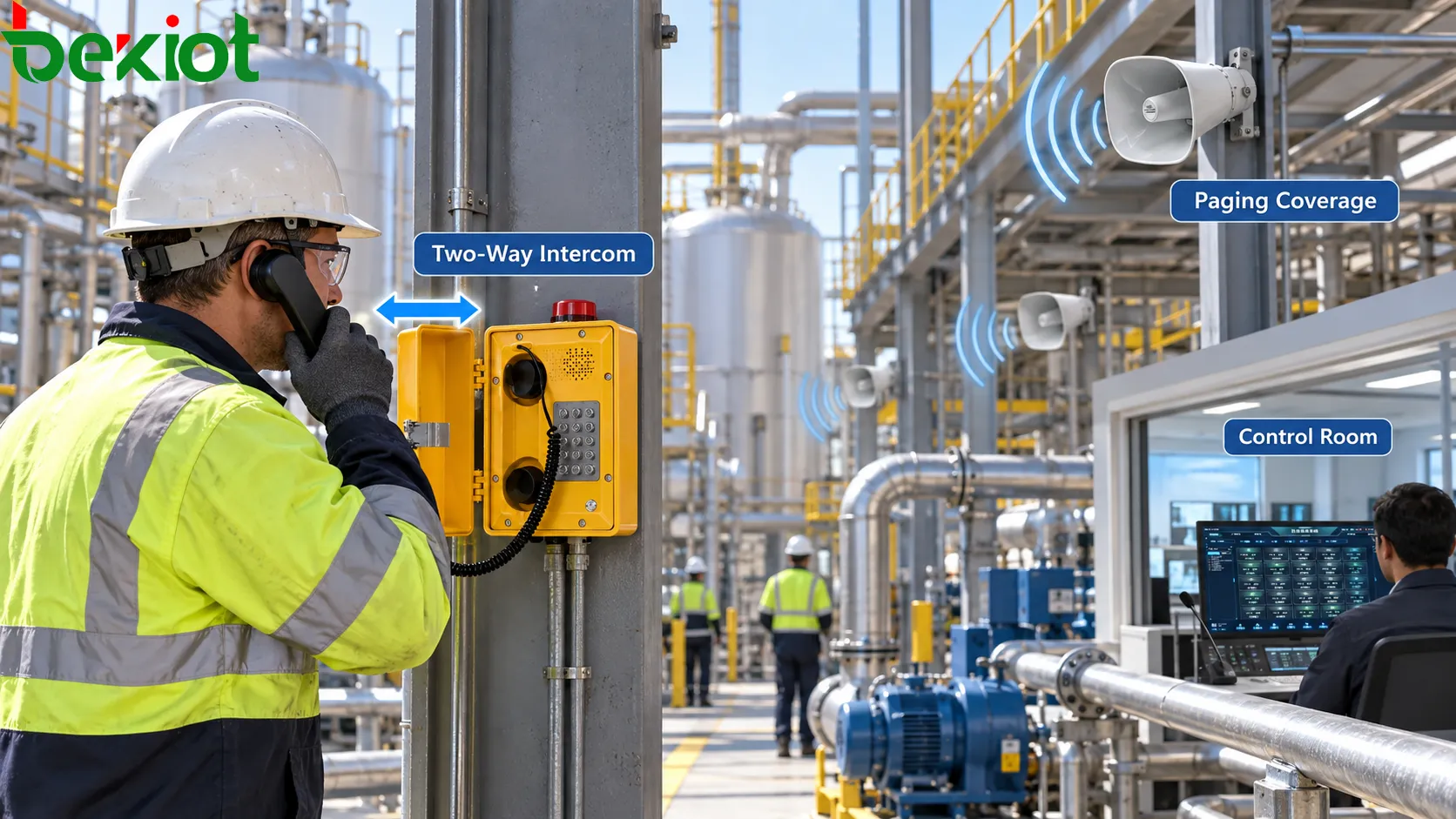
For intercom calls, test the field microphone distance and direction, local noise, echo control and half-duplex or full-duplex behavior. Compare handset and hands-free use with the actual hearing protection and work activity. Verify that both the field worker and operator understand each other under representative operating noise.
Specify SIP calling, group paging and existing-system links
A typical call path is field intercom → IP network → SIP platform → control-room console. A page may follow microphone → paging platform → selected zones → audio endpoints. SIP provides session signaling; shared SIP support alone does not guarantee paging groups, automatic answer, multicast, recording, priority or alarm integration.
-
Check routing, mutual codecs, DTMF or programmable keys, registration recovery, permissions and the complete media path.
-
For small groups, verify the capacity of individual SIP sessions. For multicast, verify sender and receiver support, switch behavior, VLAN scope and routing across subnets.
-
For analog PA, confirm gateway output, amplifier input, grounding, relay behavior and independent zone control. Radio or alarm links need their own defined signaling and audio interfaces.
Review the proposed architecture against the Paging and Intercom Broadcasting System and confirm the supported configuration for the specific project.
Define priorities, failure behavior and acceptance
Write a priority matrix covering routine announcements, operational pages, priority or emergency pages, normal field calls and emergency calls. Specify who can activate each function, whether it interrupts an active call, how overlapping zones behave and what happens to the interrupted session. Emergency use requires the applicable project and local requirements; an ordinary SIP system is not automatically a certified voice-alarm system.
Trace power and network dependencies end to end, including servers, switches, gateways, amplifiers and field stations. State which paths remain available after a fault, how calls reach a backup operator and how endpoints recover after a SIP restart. Redundancy must be demonstrated for the required workflows.
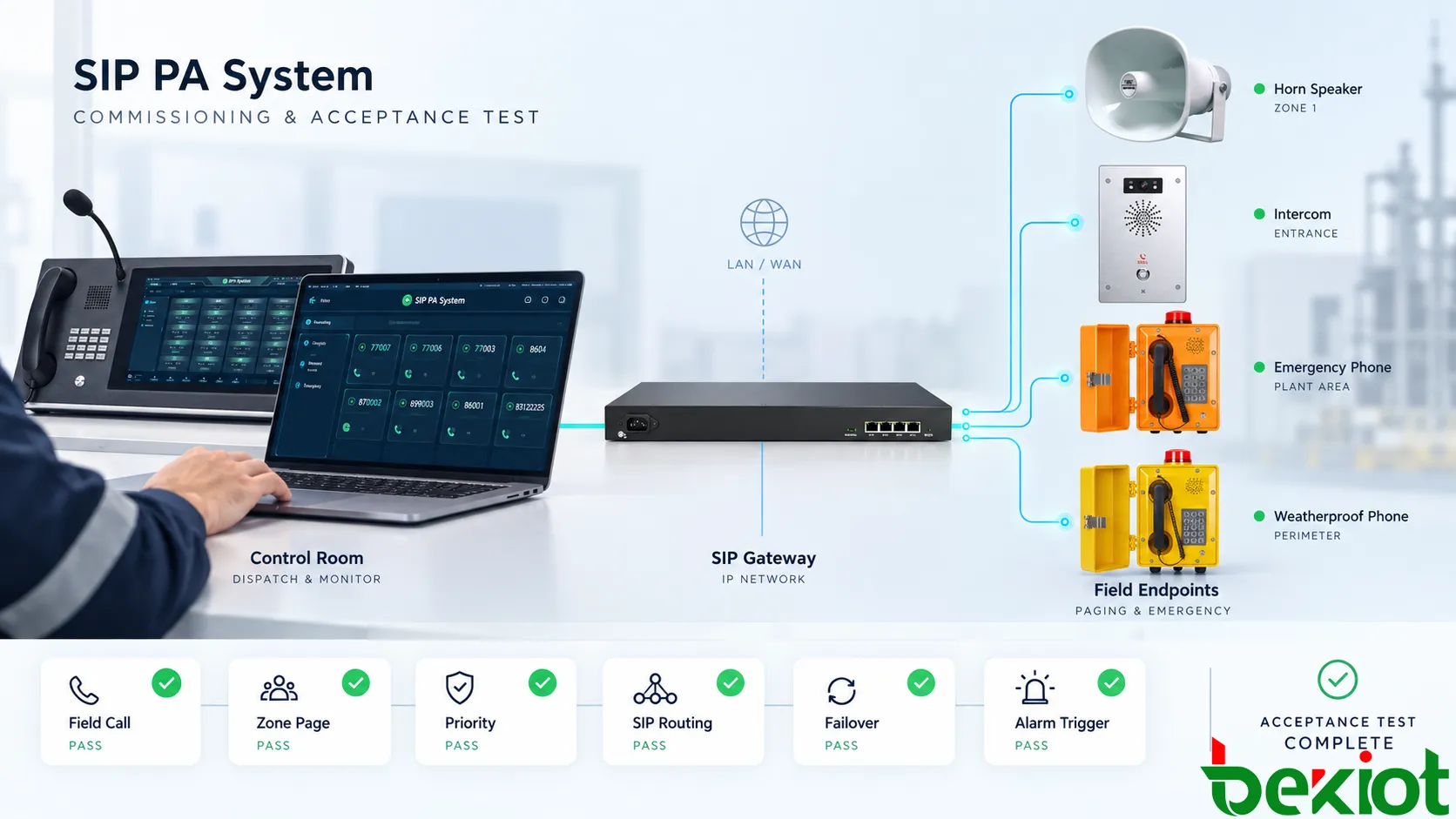
| Acceptance scenario | Required observation |
|---|---|
| Field call and emergency call | Correct operator or backup destination, clear audio in both directions and usable controls. |
| Single-zone and multi-zone paging | Only intended areas receive intelligible audio; check timing where zones overlap. |
| Paging during an active call | The documented priority and interruption rules occur. |
| Alarm-triggered page | Input, authorized logic, message, target zones and restoration operate as specified. |
| Power, amplifier or network fault | Affected paths match the resilience design; verify fallback and recovery. |
FAQs
Can paging and intercom share an IP network?
Yes, when bandwidth, QoS, segmentation, power continuity and failure paths support the expected load. Multicast needs specific network and endpoint support where used.
Is an IP speaker a substitute for an intercom?
Only if its microphone, controls and two-way behavior meet the task. A paging speaker may provide no return path at all.
Can existing analog PA equipment be retained?
Often, through a suitable gateway. Verify the actual audio, control, priority and supervision interfaces; one gateway input does not automatically provide independent control of every speaker circuit.
For a Becke Telcom project inquiry, provide the communication map, zone plan, field conditions, existing interfaces and acceptance matrix so the proposed configuration can be checked against the site requirements.
Technical references
For SIP session signaling, consult IETF RFC 3261.
For speech-intelligibility measurement methods and their limitations, consult IEC 60268-16:2020.