

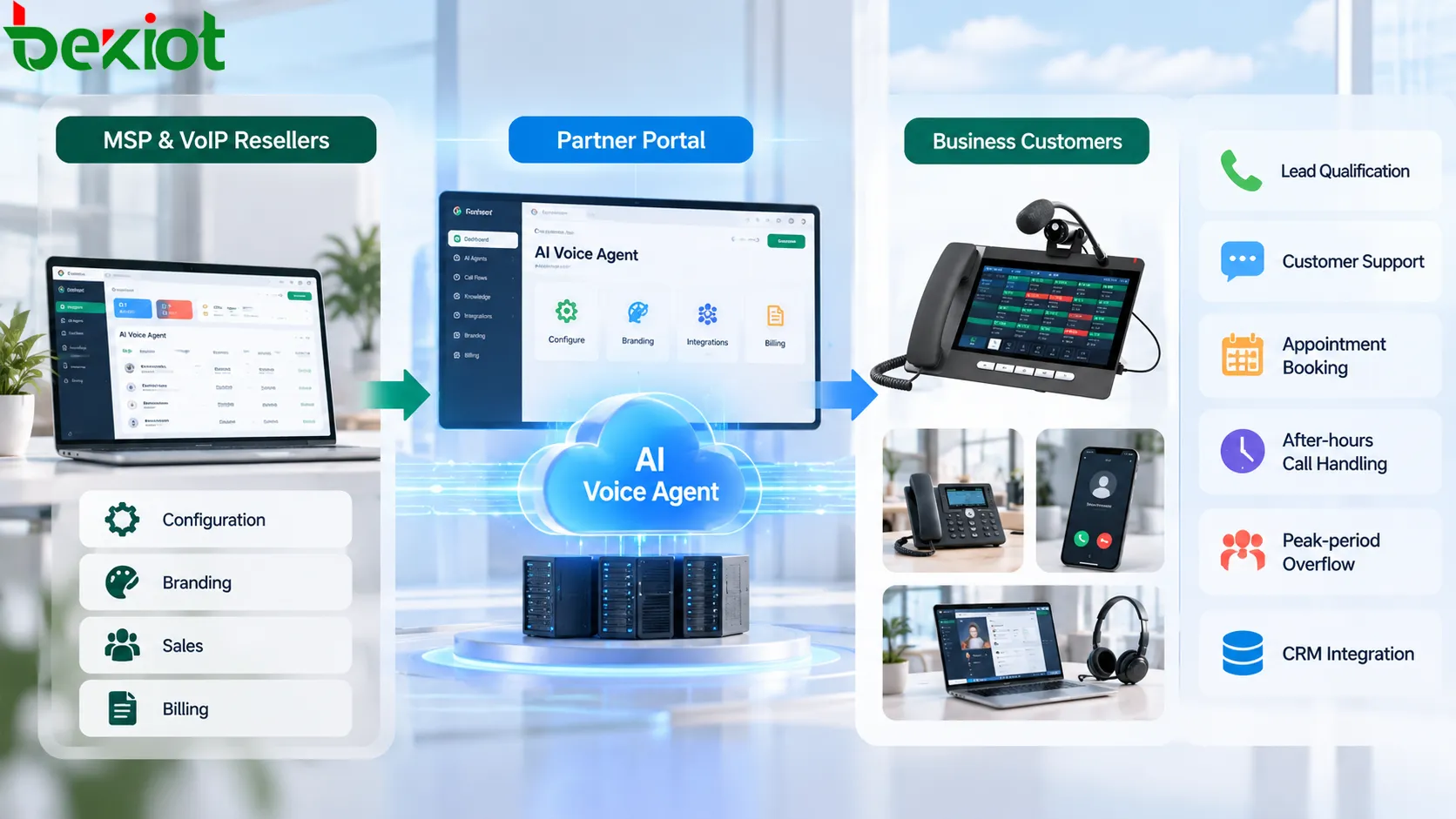
An AI voice demonstration may answer a question fluently while leaving the hardest service questions unresolved. Who owns the telephone number? What happens when the booking system times out? Which team investigates a failed transfer? For a VoIP reseller or managed service provider, those questions determine whether a voice agent can become a supportable customer service.
Delivering AI voice through the VoIP channel means combining telephony with conversation software, business-system access and an operating agreement. A customer-facing brand or provisioning portal can simplify administration, but neither proves that these components work together reliably. The service must be evaluated through its complete call flow.
Define What the Provider Is Responsible For
The customer purchases an outcome, such as routing an incoming enquiry or capturing a service request. Behind that outcome may be a carrier, a hosted or on-premises IP PBX, an AI platform and one or more business applications. The supplier agreement should assign responsibility for each boundary rather than treating “AI voice” as a single component.
| Service boundary | Responsibility to establish | Evidence for handover |
|---|---|---|
| Telephone access | Number ownership, inbound routing, permitted destinations and service continuity. | Number inventory, routing plan and tested alternate destination. |
| Conversation configuration | Approved information, supported tasks, languages and escalation rules. | Versioned configuration and representative call results. |
| Business integration | API access, permitted reads and writes, authentication and failure handling. | Scoped credentials, transaction logs and failure-path tests. |
| Operations and billing | Monitoring, incident ownership, usage definitions and change approval. | Support contacts, reporting fields and reconciled sample usage records. |
For multiple customers, treat each tenant as a separate administrative and data boundary. Validate that users can access only their assigned numbers, recordings, transcripts, knowledge sources and integration credentials. Reusing a configuration template should not copy another customer’s data or secrets.
The AI virtual receptionist overview introduces the caller-facing role. The focus here is the provider’s delivery responsibility: making that function configurable, testable and supportable for a particular customer.
Check the Four Layers of the Call Path
1. Telephone Access
Establish how calls enter and leave the service. Record the numbers, trunk or gateway arrangement, supported media formats and network boundaries. A connection accepted by the telephone platform does not prove that audio reaches the conversation service in both directions.
2. Call Control
The PBX or call-control platform determines routing, working hours, queues, transfers and fallback destinations. Test those functions with the actual integration. SIP support alone does not guarantee a particular transfer method, recording feature or AI connection.
For example, RFC 3515 defines SIP REFER and a mechanism for reporting the outcome of the referred request. It can support call transfer, but requesting or accepting a transfer is not the same as proving that the destination answered and the caller can converse with it. Some deployments instead use application-controlled bridging; the test must match the implemented method.
3. Conversation Processing
A voice agent may combine speech recognition, dialogue logic, approved knowledge and speech synthesis. More integrated speech-processing designs are also possible. Measure the complete interaction rather than assuming that one component’s processing time represents the caller’s experience.
Conventional IVR can already support speech input as well as keypad menus. The relevant comparison is therefore the scope and reliability of the required tasks. A deterministic menu may suit a simple routing requirement; a conversational agent needs additional controls when it interprets open-ended requests or generates answers.
4. Business Actions
CRM, ticketing, booking and account systems remain separate applications. Reading a record and changing it require different permissions. Validate the caller’s authority through the agreed verification process; a displayed calling number alone should not authorize access to sensitive information or account changes.
Confirm a booking or update only after the business system returns an appropriate success result. If the result is uncertain, the agent should explain that uncertainty and follow the defined recovery path. Retried requests also need duplicate protection so that a timeout does not create two bookings or tickets.
Design Human Handoff Before Expanding Automation
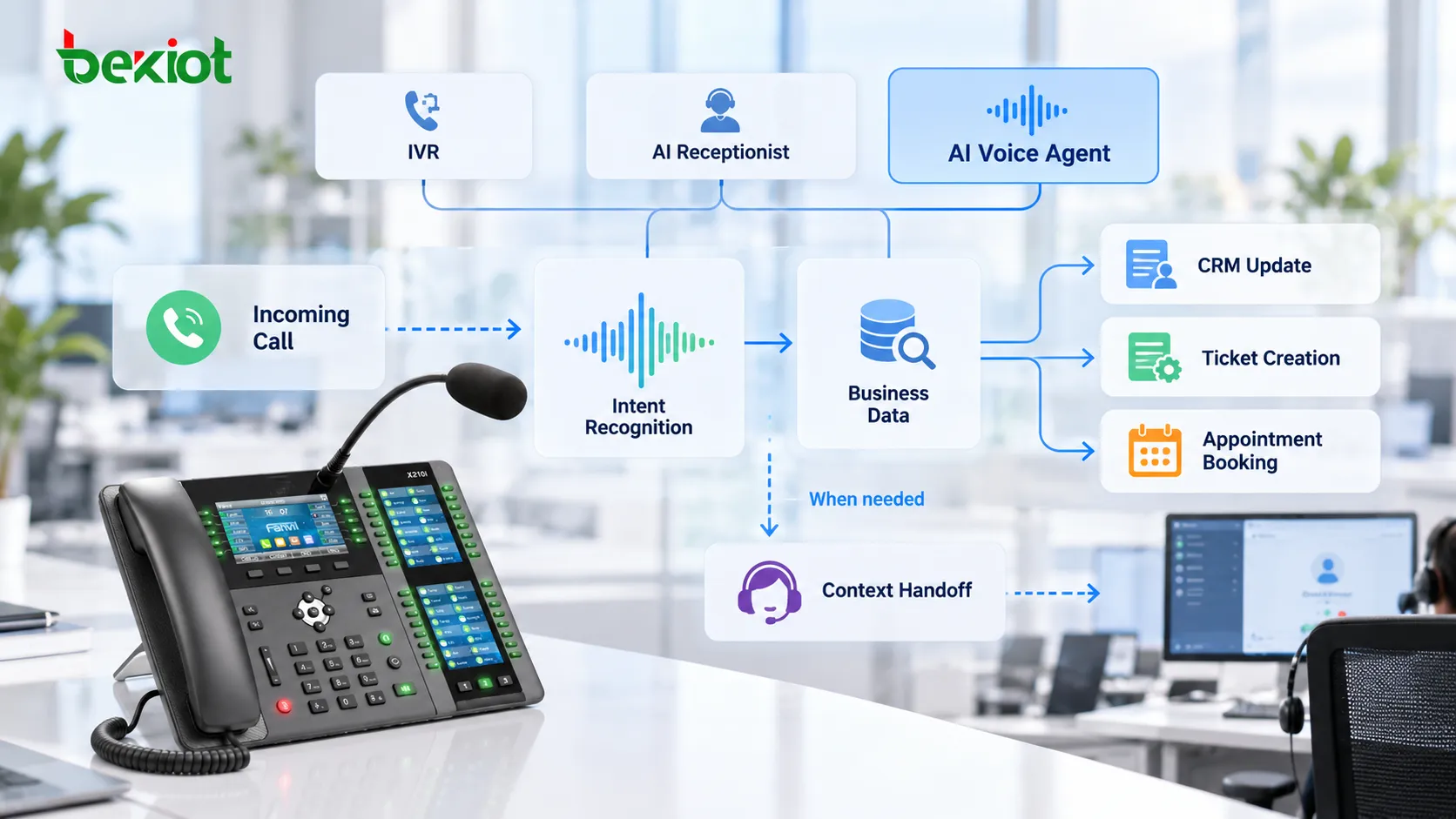
Define escalation triggers in terms an operator can verify: the caller asks for a person, repeated misunderstanding prevents progress, the request falls outside the approved scope, or a required application is unavailable. A model’s internal confidence value should not be the only basis for deciding whether the conversation can continue safely.
Specify the destination and the failure route for each trigger. A staffed queue during business hours may become a callback request or voicemail outside those hours. Test a busy destination, no answer, a rejected transfer and a destination that answers without usable audio. Avoid loops that return the caller to the same failed automation.
Where the integration supports it, pass a concise summary to the receiving employee. Distinguish what the caller said, what the agent inferred and what a business system actually confirmed. A generated summary is useful context, not proof that a transaction completed.
For urgent or safety-related calls, establish an approved direct route and operational procedure. Do not assume a general-purpose voice agent is suitable for emergency dispatch or allow its availability to become an unexamined dependency in a critical call path.
Validate the Service with Observable Outcomes
Use an agreed test set that reflects the customer’s vocabulary, call reasons, background conditions and operating hours. The following scenarios are proposed acceptance tests, not results from a Becke Telcom deployment.
| Test | Outcome to observe |
|---|---|
| A caller interrupts a spoken response | The service handles the interruption according to its configured turn-taking behaviour and retains the relevant request. |
| An unsupported or ambiguous question | The agent seeks clarification or escalates without inventing a business policy. |
| An integration timeout after a submitted action | The service determines the transaction state or marks it uncertain before retrying or reporting success. |
| A request for a human agent | The intended destination receives the call, or the agreed failure route is used. |
| An instruction to bypass business rules | Application permissions and workflow controls still prevent unauthorized actions. |
| A service or network interruption | Callers receive the agreed alternate treatment, with an incident visible to the responsible team. |
Record task completion, failed transfers, caller abandonment, unsupported answers and end-to-end response delay with clear definitions. Separate a call answered by the platform from a task completed in the business system. Report the sample size and test conditions alongside any performance percentage.
The NIST AI Risk Management Framework provides a voluntary basis for considering AI risks through design, deployment and evaluation. It is a governance reference, not a certification that a particular voice service is accurate or appropriate for every use.
Make Changes, Usage and Support Auditable
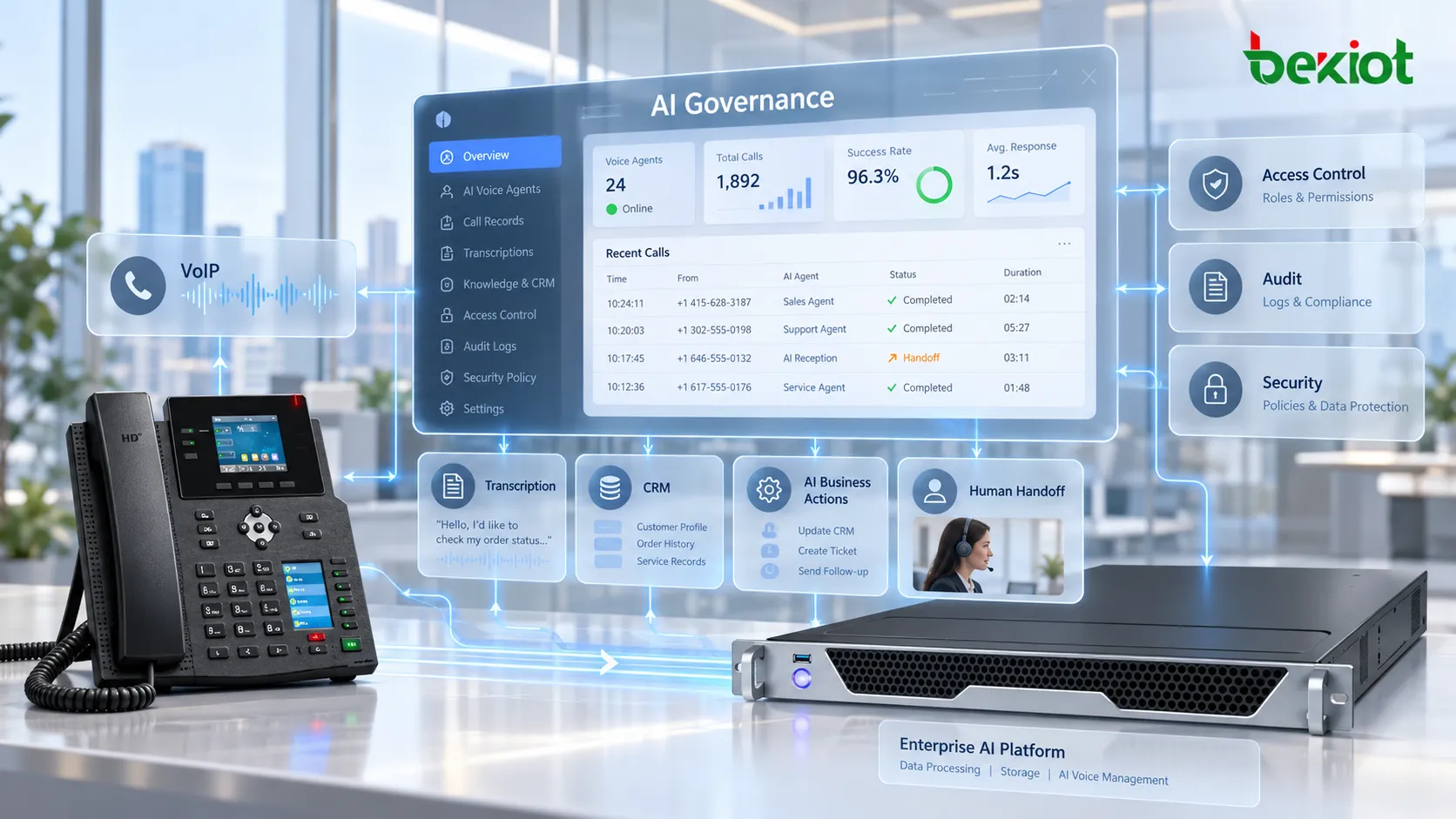
Keep a version history for prompts, approved information, call routing and integrations. Assign who can approve changes, how they are tested and how a previous working version is restored. Re-test affected scenarios after a model, configuration or business application changes.
Define recording and transcript handling for the actual deployment: what is collected, where it is stored, who may access it and when it is deleted. Apply the customer’s requirements and applicable rules to the chosen services, including external processors. Do not treat a generic privacy statement as a substitute for checking the real data path.
Usage reporting should distinguish telephone charges, AI processing and any additional service fees. A transferred call may contain more than one chargeable leg, depending on the commercial arrangement. Reconcile sample records against the supplier’s billing definitions rather than assuming that the displayed call duration equals every billable unit.
For the telephone-system foundation, the Becke Telcom VoIP telephone system overview provides a starting point for discussing extensions and call routing. Confirm the required AI service, integration interfaces, software version and support responsibilities separately for each proposed deployment.
FAQs
What should a customer receive when leaving an AI voice service?
Agree the exit process before deployment: control of telephone numbers, permitted exports of configurations and records, credential revocation and deletion of retained data. The contract and implementation determine what can be transferred; portability should not be assumed.
Can one conversation template be used across several customers?
A template can provide a starting structure, but business rules, operating hours, destinations and verification steps need customer-specific validation. Keep credentials and private knowledge outside the reusable template, and test each tenant independently.
How should capacity requirements be stated?
Specify concurrent active calls, expected arrival patterns, average interaction length and the proportion of calls transferred to people. Check limits across trunks, PBX resources, AI processing and destination queues; a limit quoted for one component does not establish capacity for the complete service.