

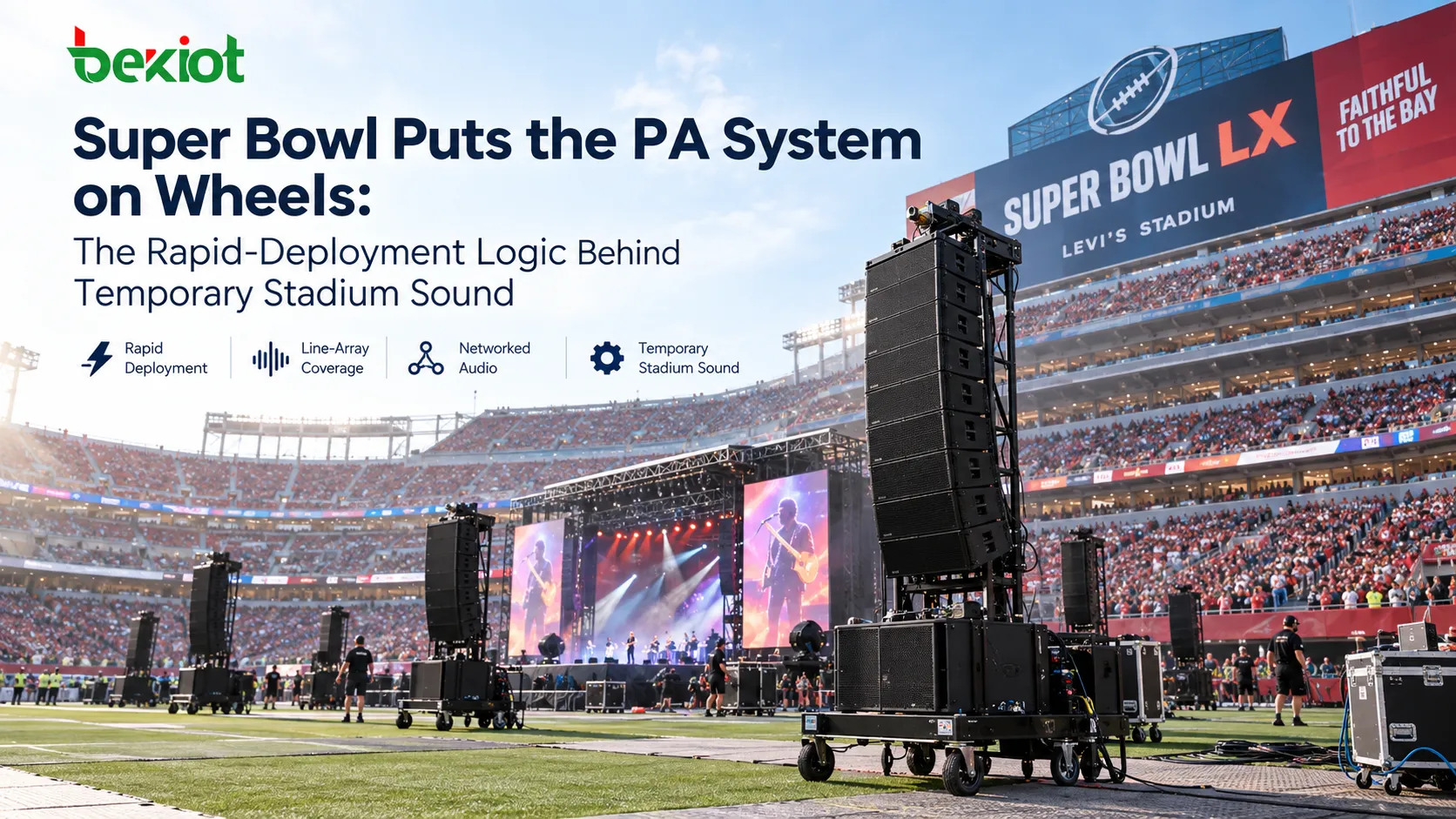
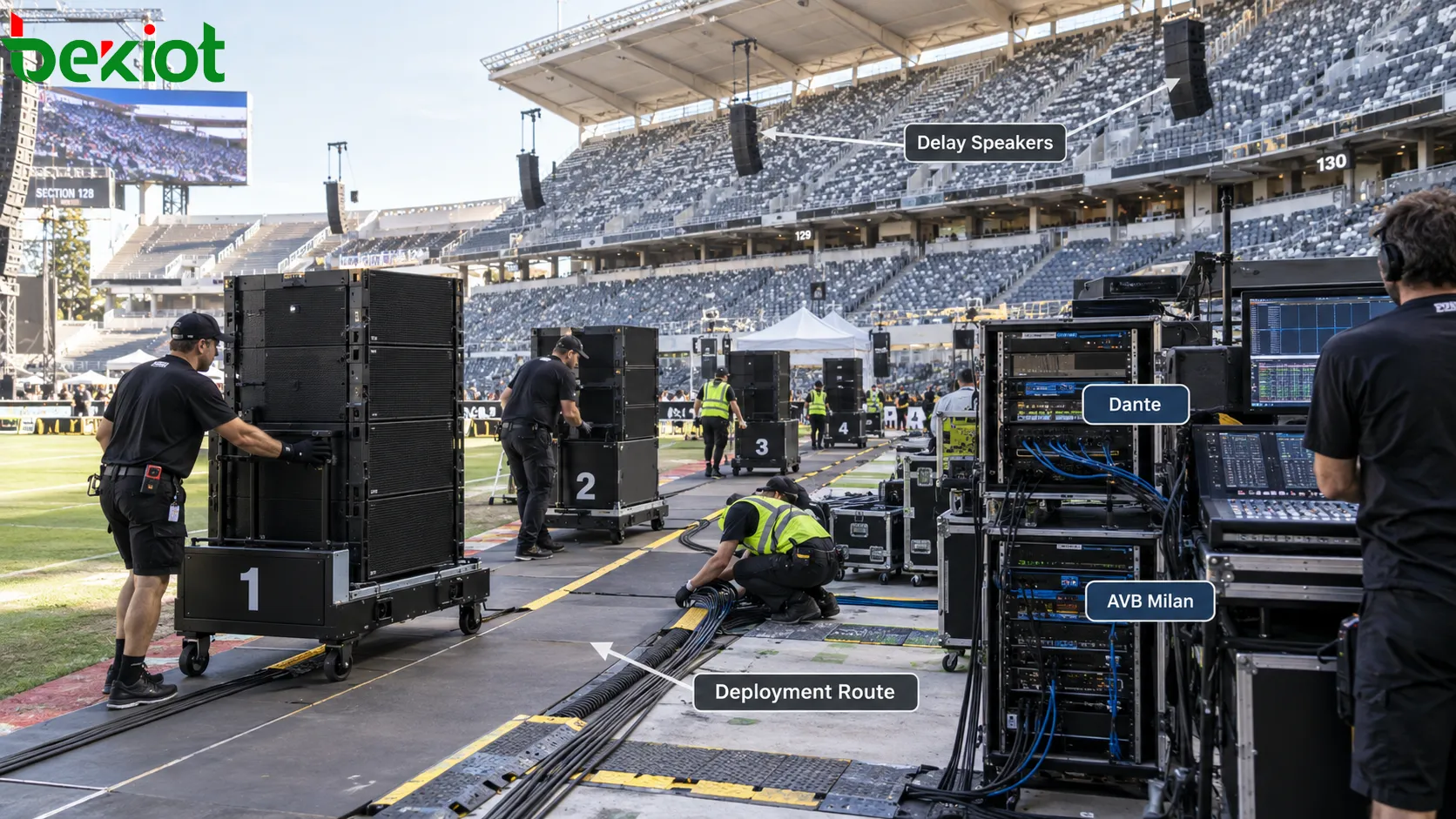
A stadium halftime show has to become a working performance space and then return to football within the event schedule. At Super Bowl LX, a temporary loudspeaker system moved into place on field carts. The practical challenge extended beyond transporting loudspeakers: their positions, connections and removal sequence had to work alongside the stage, performers and field crews.
The Levi's Stadium event page identifies February 8, 2026 as the Super Bowl LX date. David Barbour's March 2026 production feature in Lighting & Sound America, pages 47–50, describes 18 audio cart positions and distinguishes the installed game-audio system from the portable entertainment package. Its interviews also describe the pressure to protect the turf and coordinate cable access. These reported deployment facts do not establish an independently measured acoustic result.
The engineering discussion below considers what that form of deployment means for other events. It is project-planning analysis, not a reproduction of the Super Bowl design, a commissioning report or evidence of Becke involvement.
Venue Geometry Comes Before the Loudspeaker Layout
An open-air stadium, seating canopies and a fully roofed arena offer different opportunities for temporary sound. A visible roof is not proof that suitable rigging positions or load capacity are available. The design team needs approved information about support structures, access, sightlines, the playing surface and the event schedule before deciding between flown, ground-supported or mobile equipment.
Mobile carts can make a preassembled system practical where field deployment is required. They also place the sources relatively close to some listeners and far from others. Lower rows, upper decks, end zones and seats beneath a canopy therefore need separate attention. Reusing a symmetrical cart layout from a different stadium is not a substitute for examining the actual seating geometry.
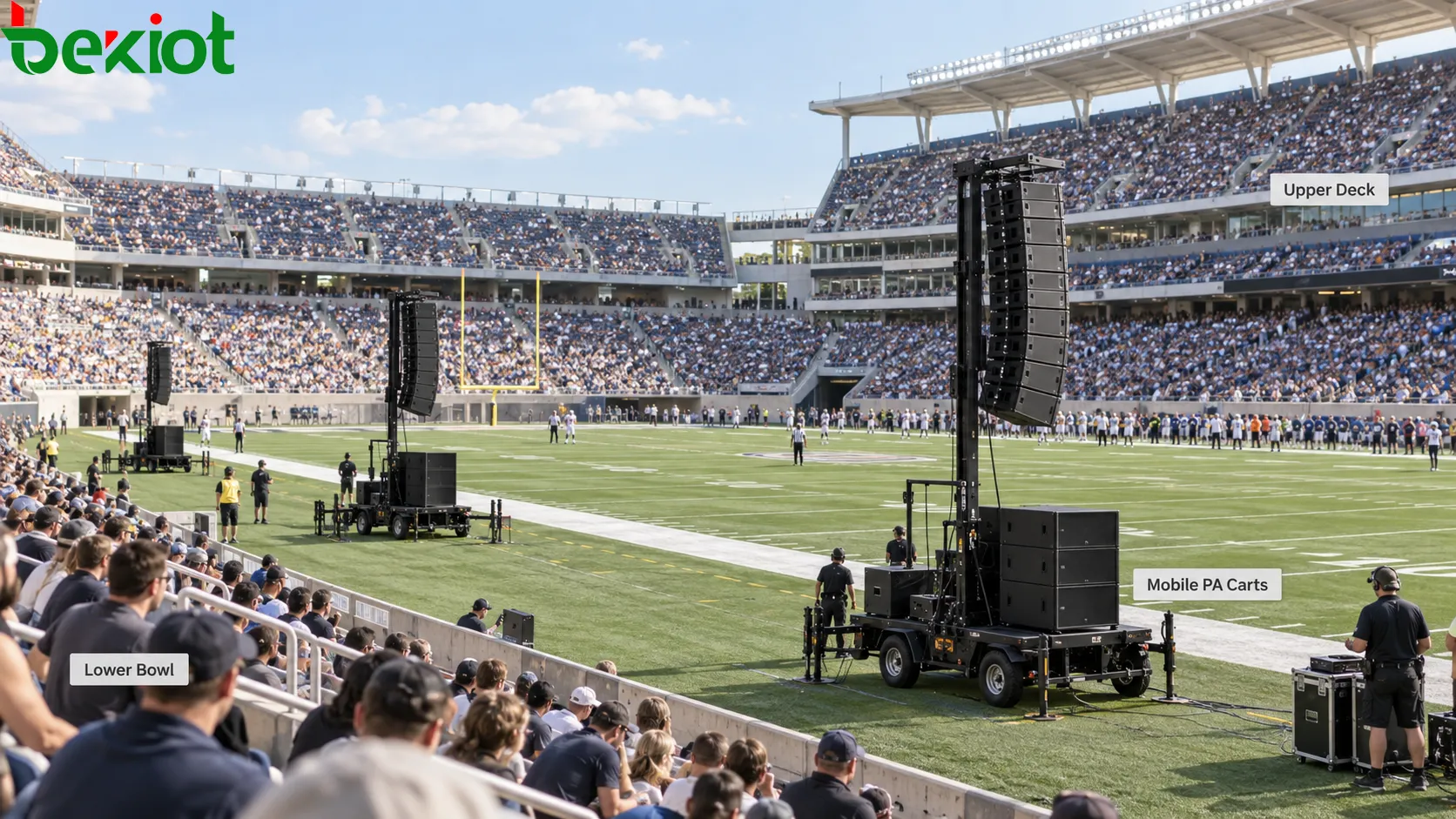
Before selecting equipment, define the audience areas and the intended program. Speech announcements and a music performance can require different coverage, tonal balance and operating levels. A project should identify which existing venue functions remain in service while temporary equipment is installed, connected and removed.
Make Each Cart a Repeatable Position
The useful feature of a cart is that mechanical support, loudspeaker arrangement and part of the connection work can be prepared before the transition. This reduces the work left for the field, but only if each unit reaches the intended location and orientation. A cart that stops several meters from its design position is no longer the same acoustic source arrangement.
Assign each unit an identifier linked to its position, configuration, power connection and audio destination. The deployment drawing should also show staging areas, the direction of travel, cable responsibilities and who confirms that the unit is ready. Different seating zones may need different configurations; a fleet of carts does not need to consist of identical acoustic packages.
Mechanical suitability remains a separate engineering question. Qualified personnel need to assess the cart, support system, stability, loads, travel surface and weather limitations using the actual equipment and venue requirements. Neither a concept illustration nor a published event description supplies an approved construction design.
Evaluate the Listening Areas, Not Just the Array Output
Coverage planning should examine the nearest and farthest listeners together. Increasing output to reach a distant tier may create excessive level close to a field-level array. Aiming, source position, available height and the division of coverage between sources all affect that tradeoff. Music also adds low-frequency and dynamic requirements that cannot be reduced to whether speech is audible.
Acoustic modeling can help compare candidate layouts before equipment arrives. Its inputs and assumptions need to match the venue, loudspeaker data and intended arrangement. A prediction should then be checked against site measurements; it is not an acceptance result merely because it is displayed as a colored coverage map.
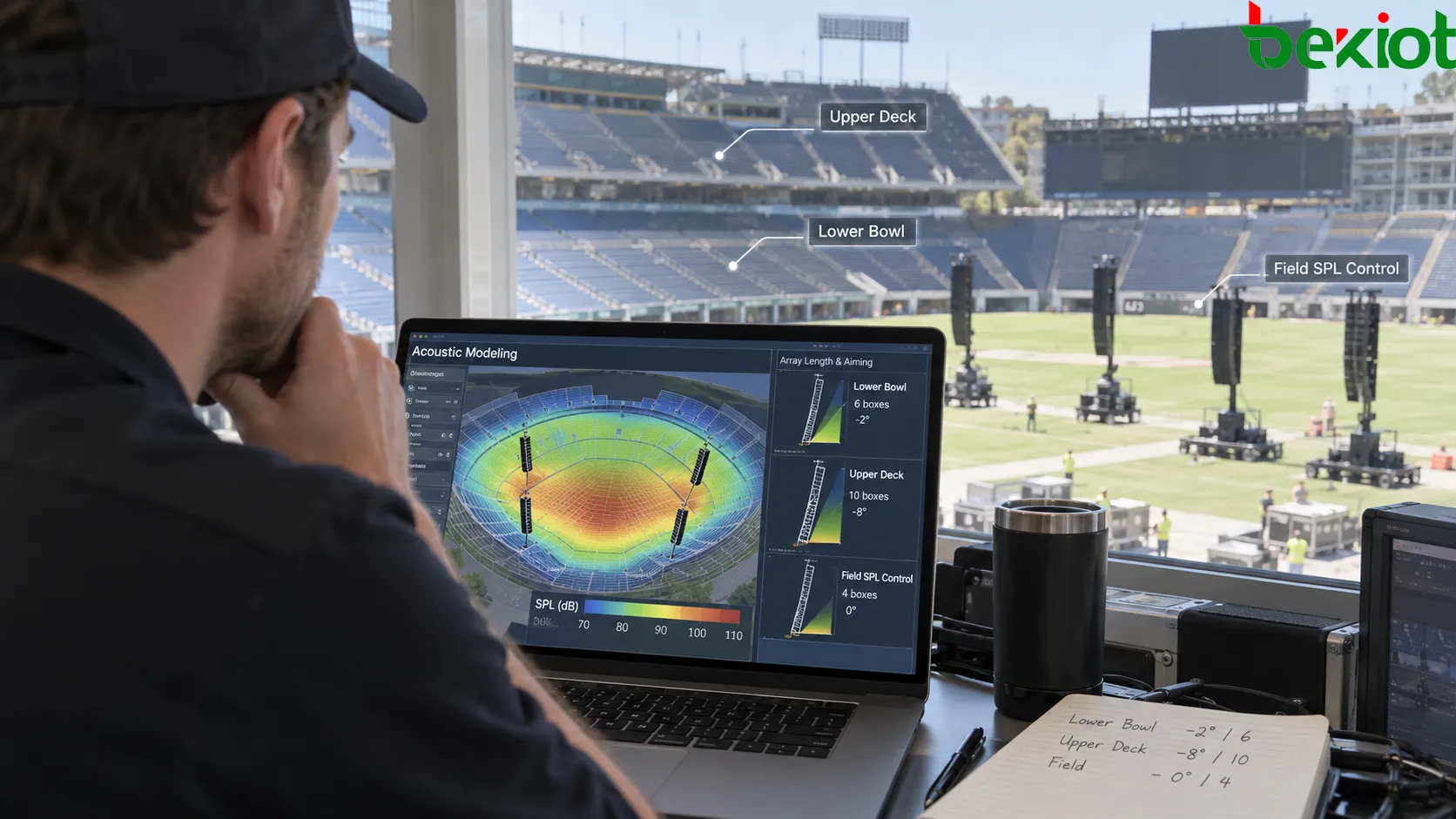
Agree the assessment locations and performance criteria before commissioning. Include representative near, far, elevated and obstructed seating, together with areas where two systems overlap. Record the operating level, signal used, weather and occupancy conditions so the result can be interpreted. The acceptable limits should come from the project brief and applicable venue requirements, not a universal number copied from an unrelated event.
Define the Interface with Installed Sound
Installed venue audio may continue to handle game announcements while the temporary package supports entertainment. Where supplementary coverage from venue loudspeakers is proposed, the team needs an interface plan covering signal ownership, processing, delay, level, muting and the return to normal operation. Suitable integration is a design decision; it is not automatic because both systems can receive audio.
Safety announcements need a separately agreed operating arrangement. Adding a concert system does not certify it as an emergency voice system or authorize it to take over life-safety functions. The venue's responsible personnel should approve how required announcements remain available throughout setup, performance and removal.
For networked audio, identify compatible interfaces, clock domains and the effect of devices joining or leaving the system. Two network ports or two cables do not by themselves demonstrate an independent backup. Document the components shared by primary and alternate paths and verify the intended recovery behavior under controlled conditions.
Rehearse Movement and Connections Together
A workable sound design can still miss the event window if equipment blocks a route or connectors cannot be reached. Plan deployment and removal as complete sequences, including the people handling cables and those confirming equipment status. A failed unit should have a defined response that does not leave a large cart obstructing another crew or an emergency access route.
The UK's Health and Safety Executive's event electrical-safety guidance highlights site layout, power needs, environmental protection and cable routes that allow safe installation and removal. It is useful planning guidance in its UK context, not evidence that a US production complied with UK rules. The event's applicable local requirements and competent electrical design remain decisive.
| Rehearsal or check | What to establish |
|---|---|
| Movement and positioning | Units reach their marked positions without blocking other operations, damaging the surface or compromising stability |
| Connections and readiness | Power and audio assignments match the drawings; the responsible operator can confirm readiness |
| Audience coverage | Agreed listening areas are assessed under documented conditions |
| System interface | Timing, levels, control handover and required venue announcements work as planned |
| Fault response | The crew knows the effect of a failed source, link or power feed and the approved response |
| Removal | Equipment is safely disconnected, moved and accounted for within the agreed transition |
Super Bowl LX provides a reported example of mobile audio deployment; it does not provide a universal stadium specification. The transferable lesson is to treat acoustics, support structures, power, signal distribution and crew movement as one coordinated project. For the different problem of renewing permanent infrastructure, the Portman Road stadium PA article considers an installed-system rebuild.