
Tin tức mới nhất
2026-11-02 14:33:44

Cộng đồng chân núi Kanlaon nhận hệ thống phát thanh công cộng

Cabagna-an đã nhận hệ thống phát thanh công cộng vào ngày 14 tháng 9 năm 2026 cho 1.601 hộ gia đình. Tin tức nêu bật nhu cầu cảnh báo cộng đồng, kèm hướng dẫn lập kế hoạch về phạm vi phủ sóng, thông điệp, nguồn điện và k

Becke Telcom

Cộng đồng chân núi Kanlaon nhận hệ thống phát thanh công cộng

Barangay Cabagna-an, at the foot of Kanlaon Volcano in La Castellana, Negros Occidental, received a public address (PA) system on 14 September 2026. A Philippine News Agency report published the following day said the facility was expected to benefit 1,601 households, or 4,473 residents, through community announcements, public advisories and emergency alerts.

The Department of Social Welfare and Development–Negros Island Region turned over the project under the KALAHI-CIDSS KKB-CDD community-driven development programme. The report describes its communication purpose; it does not identify Becke Telcom as a supplier or document the installed equipment, acoustic coverage, backup duration or failover performance.

Why the Kanlaon community needs a clear warning channel

The setting gives the news practical significance. In its 1 September 2026 bulletin, PHIVOLCS placed Kanlaon at Alert Level 2 and warned against entry into the 4-kilometre Permanent Danger Zone. That dated bulletin provides context, rather than a current evacuation instruction. Residents and operators must follow the latest official bulletins and local government directions.

PA can bring an authorized message into a shared physical space without requiring every resident to open an application. It cannot monitor the volcano, predict an eruption or confirm that everyone has heard and understood a warning. Mobile alerts, radio, field teams and assistance for residents who cannot hear the announcement remain important.
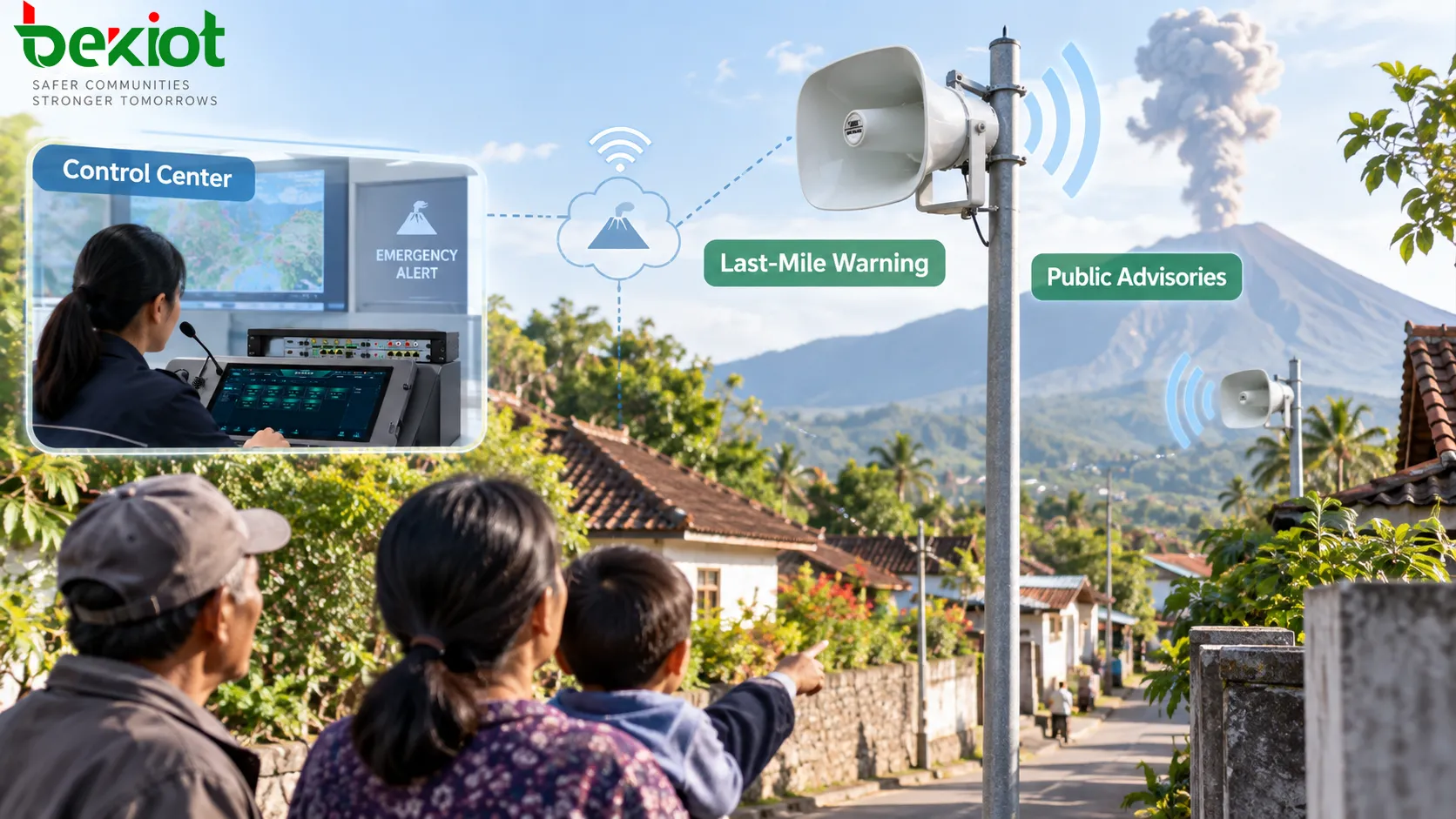
Illustration of residents, an outdoor horn speaker and a control-centre inset near a volcano

Coverage and zoning should follow the response plan

The following are planning considerations for comparable community projects, not verified specifications of Cabagna-an’s system. Survey homes, roads, schools, assembly points and evacuation routes before choosing loudspeaker positions. Terrain, wind, buildings and background noise can leave areas where a message is audible but unintelligible.

Define broadcast zones around the areas that may need different instructions. An affected neighbourhood may need to move while another area needs to keep a route clear. Zone names and operator controls should match the local response plan, and intelligibility should be checked at representative listening positions, including coverage boundaries.

A warning must explain the required action

Approved messages should identify the issuing authority, affected area, required action, safe destination or route, and where the next update will come from. Use languages residents understand. Prepare recordings for agreed scenarios, but keep a controlled live-announcement method for changes that a recording cannot cover.

Emergency priority and the ability to interrupt routine audio must be specified and tested on the selected platform. A SIP connection alone does not provide evacuation logic, automatic hazard detection or authorization to issue an alert. Local authorities decide when to activate a message and who may change it.
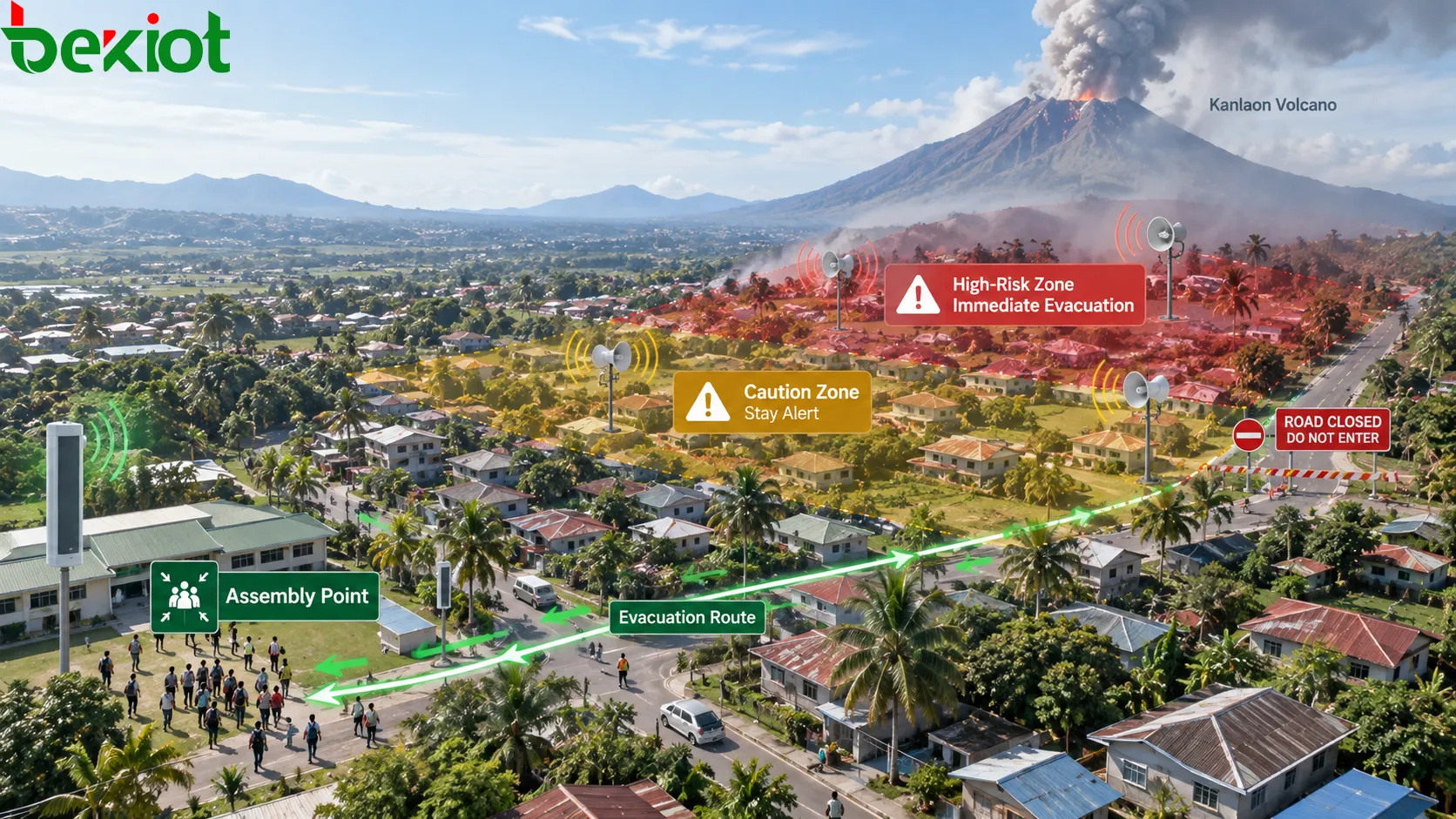
Illustration of a volcanic settlement with coloured risk areas, an evacuation route and an assembly point
Illustration of a volcanic settlement

Network loss and power loss need separate plans

Map every dependency between the microphone, controller, network equipment, amplifier and loudspeaker. A distributed layout can limit some failures, but it does not automatically provide redundancy. Central and remote equipment both need a power strategy, maintenance access and a defined response to loss of communication.

Stored messages and local activation can preserve selected functions only when the endpoint, controller or local subsystem explicitly supports them. Establish who can activate them during a network outage and how conflicting messages are prevented. Backup power duration must come from the site’s risk assessment, measured load and operating plan, rather than an assumed universal value.
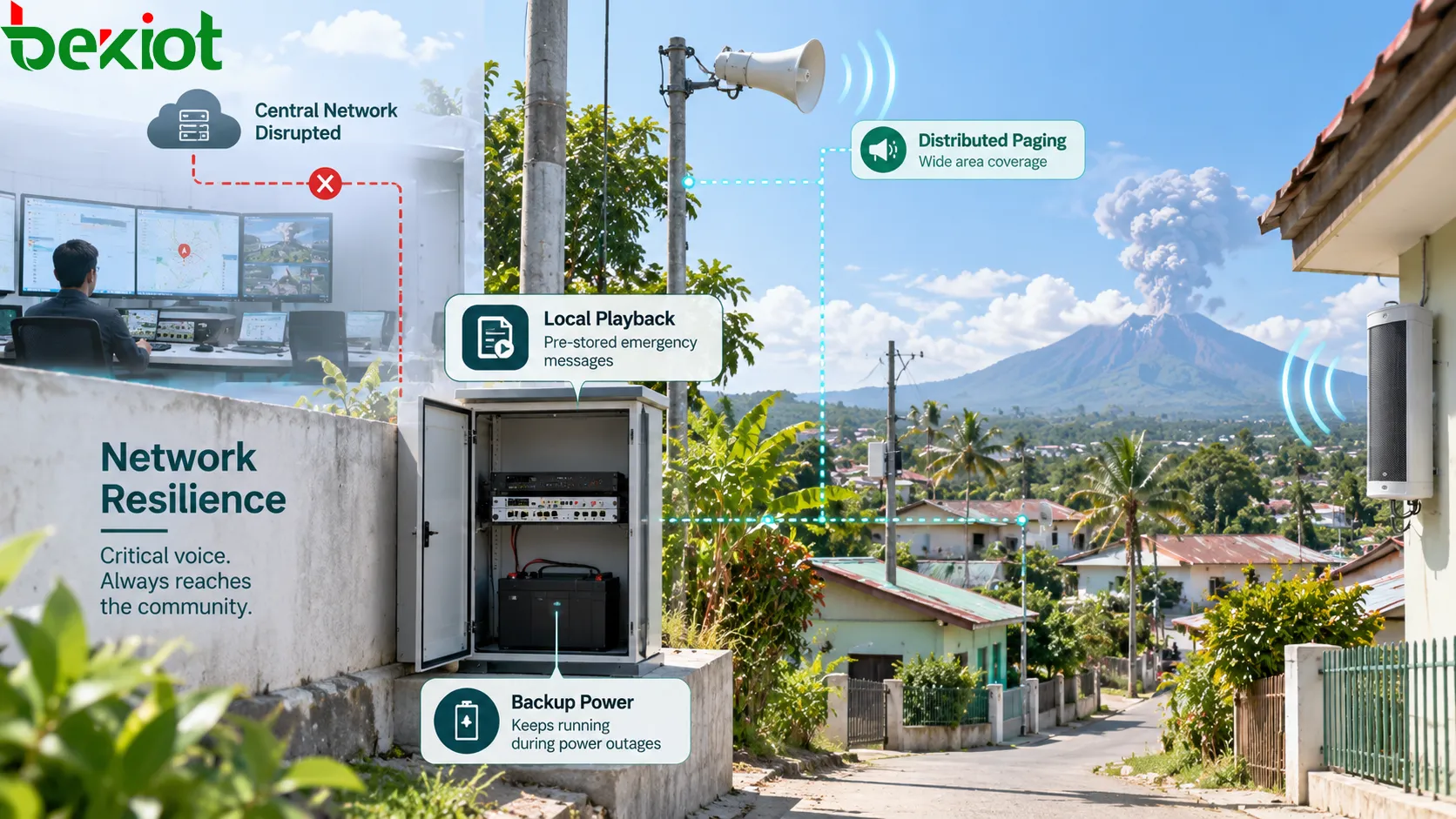
Illustration of a PA cabinet, backup power and local playback beside a community street
Conceptual resilience measures: local playback, backup power and distributed paging require project-specific verification.

Acceptance should include residents and controlled failures

Test each zone, message priority and live announcement at representative locations. Under an approved test plan, simulate loss of the central link, a paging node and mains power, and record which functions remain available. Coordinate testing so that residents can distinguish a drill from a real alert and essential warning coverage is maintained.

Field teams also need a return channel to report blocked routes, people requiring help and areas that did not receive the warning. Radio, telephone or intercom links can support that feedback when the wider architecture provides them. For the wider design issue, see the discussion of secondary emergency communication paths.

The Cabagna-an handover is a community communication development, not proof that every proposed resilience feature has been installed. Its practical lesson is to connect timely official information with messages people can understand and act on, then verify that process through maintenance and community drills.

FAQs

Does the public report establish who supplied the system?

No. The government report identifies the handover, programme and intended beneficiaries. It does not establish Becke Telcom participation or a product configuration, so this article makes no such claim.

Can local playback be assumed for every IP loudspeaker?

No. Storage, local triggering, permissions and operation without the server are separate capabilities. Confirm them for the actual hardware, firmware and control architecture, then test the required outage scenario.

Can a loudspeaker warning replace other public alerts?

No. Indoor listening conditions, hearing needs and people outside the coverage area require complementary channels and assistance. The response plan should provide more than one way to receive instructions and report a problem.

Sources

Event details: Philippine News Agency, 15 September 2026. Dated volcanic context: PHIVOLCS Kanlaon bulletin, 1 September 2026.


Sản phẩm đề xuất
Danh mục
dịch vụ khách hàng Điện thoại
We use cookie to improve your online experience. By continuing to browse this website, you agree to our use of cookie.

Cookies

This Cookie Policy explains how we use cookies and similar technologies when you access or use our website and related services. Please read this Policy together with our Terms and Conditions and Privacy Policy so that you understand how we collect, use, and protect information.

By continuing to access or use our Services, you acknowledge that cookies and similar technologies may be used as described in this Policy, subject to applicable law and your available choices.

Updates to This Cookie Policy

We may revise this Cookie Policy from time to time to reflect changes in legal requirements, technology, or our business practices. When we make updates, the revised version will be posted on this page and will become effective from the date of publication unless otherwise required by law.

Where required, we will provide additional notice or request your consent before applying material changes that affect your rights or choices.

What Are Cookies?

Cookies are small text files placed on your device when you visit a website or interact with certain online content. They help websites recognize your browser or device, remember your preferences, support essential functionality, and improve the overall user experience.

In this Cookie Policy, the term “cookies” also includes similar technologies such as pixels, tags, web beacons, and other tracking tools that perform comparable functions.

Why We Use Cookies

We use cookies to help our website function properly, remember user preferences, enhance website performance, understand how visitors interact with our pages, and support security, analytics, and marketing activities where permitted by law.

We use cookies to keep our website functional, secure, efficient, and more relevant to your browsing experience.

Categories of Cookies We Use

Strictly Necessary Cookies

These cookies are essential for the operation of the website and cannot be disabled in our systems where they are required to provide the service you request. They are typically set in response to actions such as setting privacy preferences, signing in, or submitting forms.

Without these cookies, certain parts of the website may not function correctly.

Functional Cookies

Functional cookies enable enhanced features and personalization, such as remembering your preferences, language settings, or previously selected options. These cookies may be set by us or by third-party providers whose services are integrated into our website.

If you disable these cookies, some services or features may not work as intended.

Performance and Analytics Cookies

These cookies help us understand how visitors use our website by collecting information such as traffic sources, page visits, navigation behavior, and general interaction patterns. In many cases, this information is aggregated and does not directly identify individual users.

We use this information to improve website performance, usability, and content relevance.

Targeting and Advertising Cookies

These cookies may be placed by our advertising or marketing partners to help deliver more relevant ads and measure the effectiveness of campaigns. They may use information about your browsing activity across different websites and services to build a profile of your interests.

These cookies generally do not store directly identifying personal information, but they may identify your browser or device.

First-Party and Third-Party Cookies

Some cookies are set directly by our website and are referred to as first-party cookies. Other cookies are set by third-party services, such as analytics providers, embedded content providers, or advertising partners, and are referred to as third-party cookies.

Third-party providers may use their own cookies in accordance with their own privacy and cookie policies.

Information Collected Through Cookies

Depending on the type of cookie used, the information collected may include browser type, device type, IP address, referring website, pages viewed, time spent on pages, clickstream behavior, and general usage patterns.

This information helps us maintain the website, improve performance, enhance security, and provide a better user experience.

Your Cookie Choices

You can control or disable cookies through your browser settings and, where available, through our cookie consent or preference management tools. Depending on your location, you may also have the right to accept or reject certain categories of cookies, especially those used for analytics, personalization, or advertising purposes.

Please note that blocking or deleting certain cookies may affect the availability, functionality, or performance of some parts of the website.

Restricting cookies may limit certain features and reduce the quality of your experience on the website.

Cookies in Mobile Applications

Where our mobile applications use cookie-like technologies, they are generally limited to those required for core functionality, security, and service delivery. Disabling these essential technologies may affect the normal operation of the application.

We do not use essential mobile application cookies to store unnecessary personal information.

How to Manage Cookies

Most web browsers allow you to manage cookies through browser settings. You can usually choose to block, delete, or receive alerts before cookies are stored. Because browser controls vary, please refer to your browser provider’s support documentation for details on how to manage cookie settings.

Contact Us

If you have any questions about this Cookie Policy or our use of cookies and similar technologies, please contact us at support@becke.cc .